
Supply Chain
Warehouse Automation Consultants
With our warehouse automation consultants on board, optimising your warehouse automation system is guaranteed to be a smooth and efficient process. We’ll ensure your automation solution is perfectly tailored to support your business’s unique needs and future growth plans.
Warehouse Automation
Which processes can be automated in the warehouse?
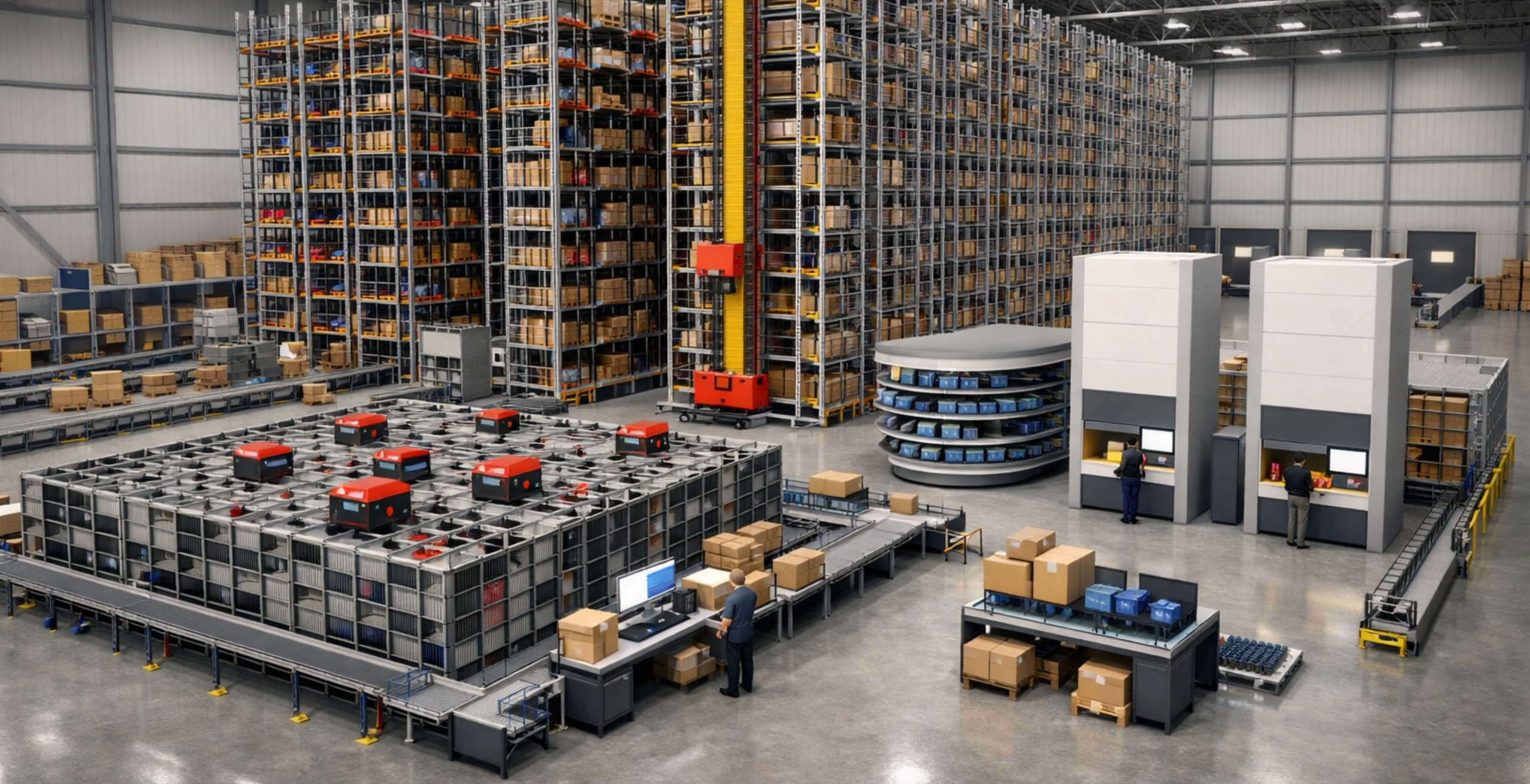
Our warehouse automation process turns objectives into outcomes. Whether exploring feasibility, partway through design, or recovering an in-flight project, we can join, stabilise, and accelerate.
1
Shuttle Systems
×
Shuttle Systems
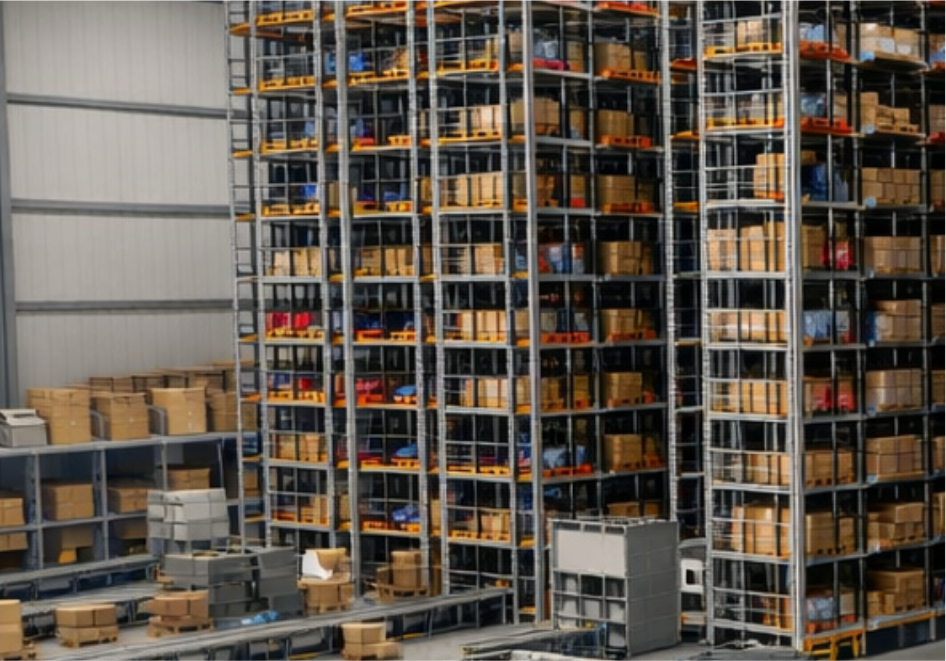
Warehouse shuttle systems employ battery-powered carts that travel horizontally on rails within racking structures, transporting pallets or totes between picking stations and storage positions. The shuttle itself is a compact, autonomous vehicle equipped with lifting mechanisms and sensors that enable it to navigate the racking channels precisely.
These automated pallet shuttle systems integrate with vertical lifts or conveyors that move goods between levels, creating a three-dimensional storage grid. A central control system coordinates multiple shuttles operating simultaneously, directing them to optimal storage locations based on velocity, product characteristics, and order requirements.
2
Stacker Crane AS/RS
×
Stacker Crane AS/RS
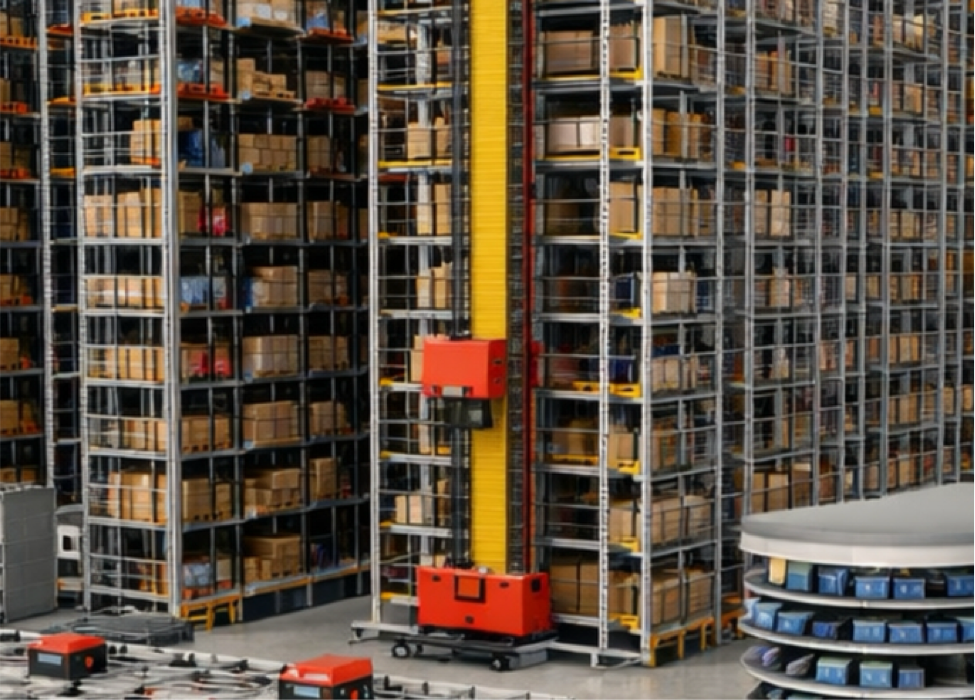
A stacker crane warehouse system utilises tall, rail-guided machines that traverse aisles, reaching vertically to access storage locations at various heights. The warehouse crane itself comprises a vertical mast with a load handling platform that can extend horizontally to place or retrieve pallets, bins, or containers from racking on either side of the aisle.
These AS/RS automated storage retrieval system configurations typically feature a dedicated stacker crane for each aisle, with the crane controlled by sophisticated software that optimises travel paths and manages dual-cycle operations (simultaneously storing and retrieving during a single trip). The stacker crane travels on floor-mounted rails with an upper guide rail ensuring stability, particularly important given the heights these systems can reach—often 30 metres or more.
3
Carousel Systems
×
Carousel Systems
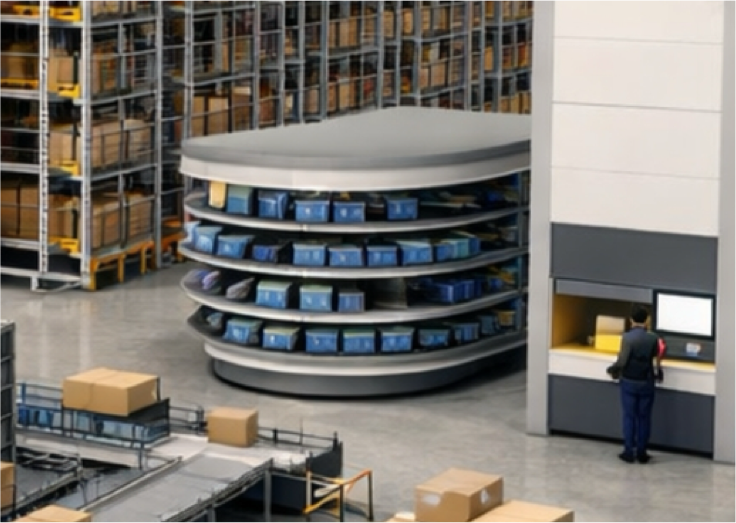
Carousel storage systems bring inventory to the operator rather than sending workers into the racking. A horizontal carousel storage system consists of bins or shelves mounted on an oval track that rotates horizontally, delivering the requested item to an ergonomic pick station. Multiple carousels often work together in a pod configuration, with software directing the optimal carousel to rotate whilst the operator completes picks from others.
Vertical carousel racking systems operate on the same principle but rotate vertically, like a Ferris wheel. Shelves carrying inventory rotate to present items at an optimal picking height, eliminating reaching, bending, or climbing. Both configurations use the “goods-to-person” principle that fundamentally changes the picking process.
4
Vertical Lift Modules
×
Vertical Lift Modules
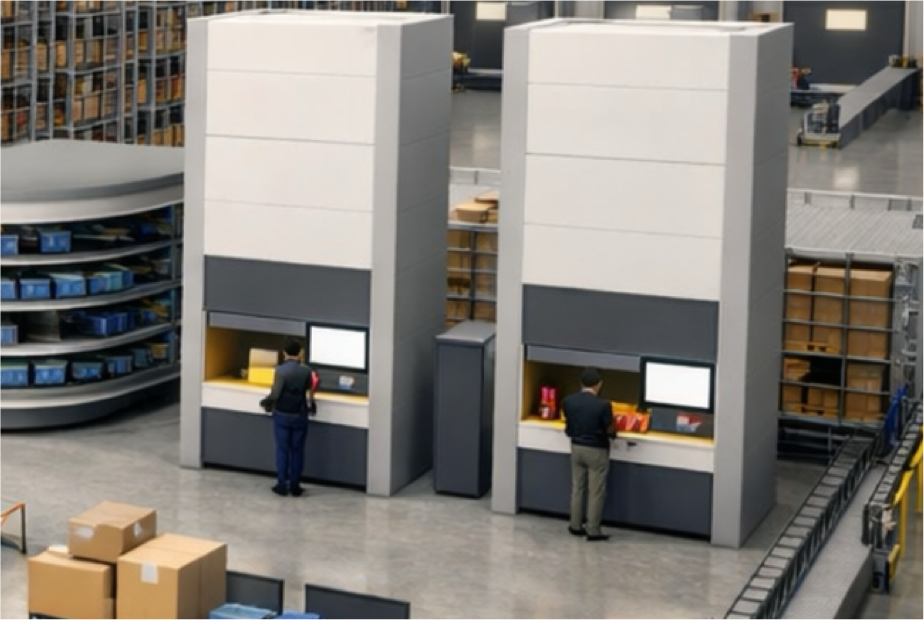
A vertical lift module storage system comprises two columns of trays with an automated extractor mechanism running between them. When an operator requests an item, the vertical lift module system’s extractor retrieves the appropriate tray and delivers it to an access opening at an ergonomic height. After the pick or putaway is complete, the tray returns to its storage position.
The vertical lift module manages density dynamically; as inventory is depleted, the system can adjust tray spacing to eliminate wasted vertical space. Software tracks every transaction, maintaining perpetual inventory accuracy and providing data for optimisation. Multiple access openings can serve different operators or processes simultaneously from a single VLM unit.
5
Cube-Based Storage Systems
×
Cube-Based Storage Systems
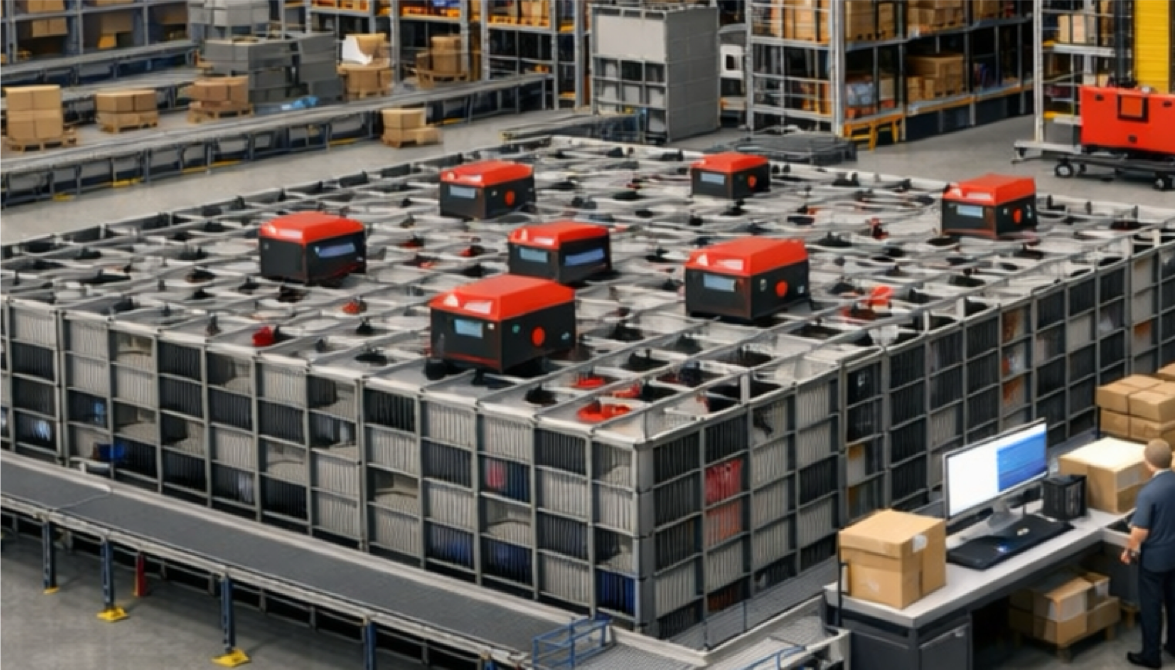
Cube based storage represents the latest evolution in automated storage technology. These systems create a three-dimensional grid of storage bins accessed by robots that travel on top of the grid structure. The robots can move both horizontally and, through clever cooperation, enable vertical movement of bins within the grid. When inventory is needed, robots retrieve the required bin and deliver it to a picking station at the grid’s perimeter.
The system’s intelligence lies in its ability to store bins with high-velocity items near the top and periphery of the grid for faster access, whilst slower-moving inventory occupies deeper positions. Multiple robots work simultaneously, and the system can dynamically reconfigure storage positions based on changing demand patterns without human intervention.
1
Shuttle Systems
Shuttle Systems
Warehouse shuttle systems employ battery-powered carts that travel horizontally on rails within racking structures, transporting pallets or totes between picking stations and storage positions. The shuttle itself is a compact, autonomous vehicle equipped with lifting mechanisms and sensors that enable it to navigate the racking channels precisely.
These automated pallet shuttle systems integrate with vertical lifts or conveyors that move goods between levels, creating a three-dimensional storage grid. A central control system coordinates multiple shuttles operating simultaneously, directing them to optimal storage locations based on velocity, product characteristics, and order requirements.
2
Stacker Crane AS/RS
Stacker Crane AS/RS
A stacker crane warehouse system utilises tall, rail-guided machines that traverse aisles, reaching vertically to access storage locations at various heights. The warehouse crane itself comprises a vertical mast with a load handling platform that can extend horizontally to place or retrieve pallets, bins, or containers from racking on either side of the aisle.
These AS/RS automated storage retrieval system configurations typically feature a dedicated stacker crane for each aisle, with the crane controlled by sophisticated software that optimises travel paths and manages dual-cycle operations (simultaneously storing and retrieving during a single trip). The stacker crane travels on floor-mounted rails with an upper guide rail ensuring stability, particularly important given the heights these systems can reach—often 30 metres or more.
3
Carousel Systems
Carousel Systems
Carousel storage systems bring inventory to the operator rather than sending workers into the racking. A horizontal carousel storage system consists of bins or shelves mounted on an oval track that rotates horizontally, delivering the requested item to an ergonomic pick station. Multiple carousels often work together in a pod configuration, with software directing the optimal carousel to rotate whilst the operator completes picks from others.
Vertical carousel racking systems operate on the same principle but rotate vertically, like a Ferris wheel. Shelves carrying inventory rotate to present items at an optimal picking height, eliminating reaching, bending, or climbing. Both configurations use the “goods-to-person” principle that fundamentally changes the picking process.
4
Vertical Lift Modules
Vertical Lift Modules
A vertical lift module storage system comprises two columns of trays with an automated extractor mechanism running between them. When an operator requests an item, the vertical lift module system’s extractor retrieves the appropriate tray and delivers it to an access opening at an ergonomic height. After the pick or putaway is complete, the tray returns to its storage position.
The vertical lift module manages density dynamically; as inventory is depleted, the system can adjust tray spacing to eliminate wasted vertical space. Software tracks every transaction, maintaining perpetual inventory accuracy and providing data for optimisation. Multiple access openings can serve different operators or processes simultaneously from a single VLM unit.
5
Cube-Based Storage Systems
Cube-Based Storage Systems
Cube based storage represents the latest evolution in automated storage technology. These systems create a three-dimensional grid of storage bins accessed by robots that travel on top of the grid structure. The robots can move both horizontally and, through clever cooperation, enable vertical movement of bins within the grid. When inventory is needed, robots retrieve the required bin and deliver it to a picking station at the grid’s perimeter.
The system’s intelligence lies in its ability to store bins with high-velocity items near the top and periphery of the grid for faster access, whilst slower-moving inventory occupies deeper positions. Multiple robots work simultaneously, and the system can dynamically reconfigure storage positions based on changing demand patterns without human intervention.
1
Tow/Tugger AGV
×
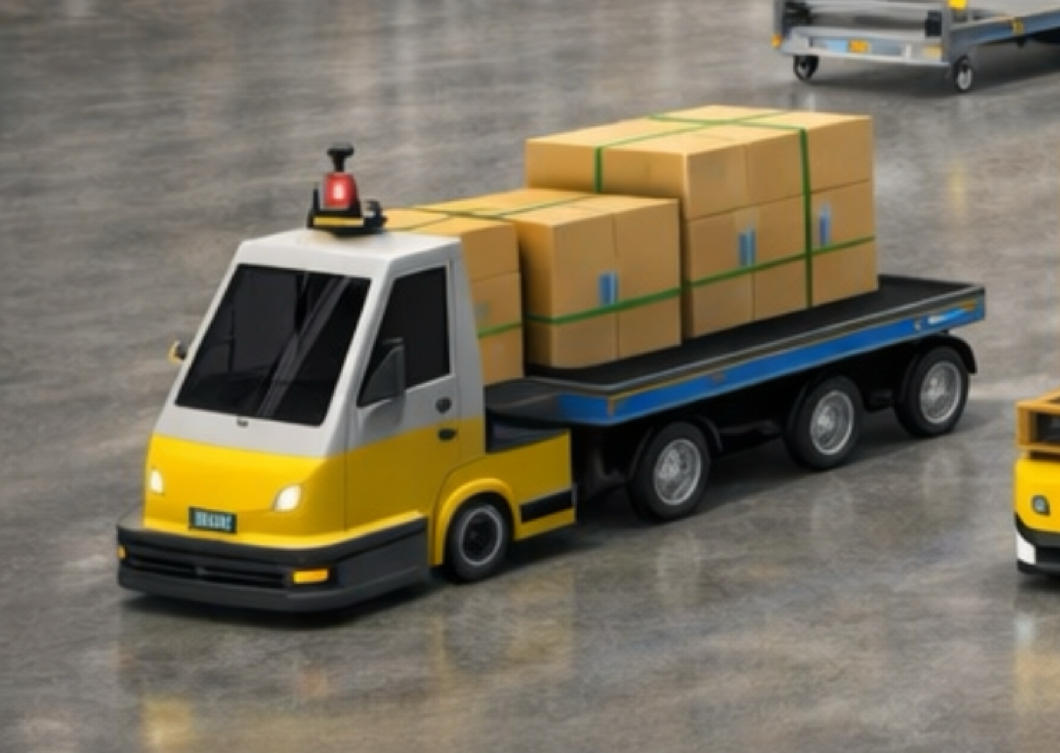
Tow/Tugger AGV
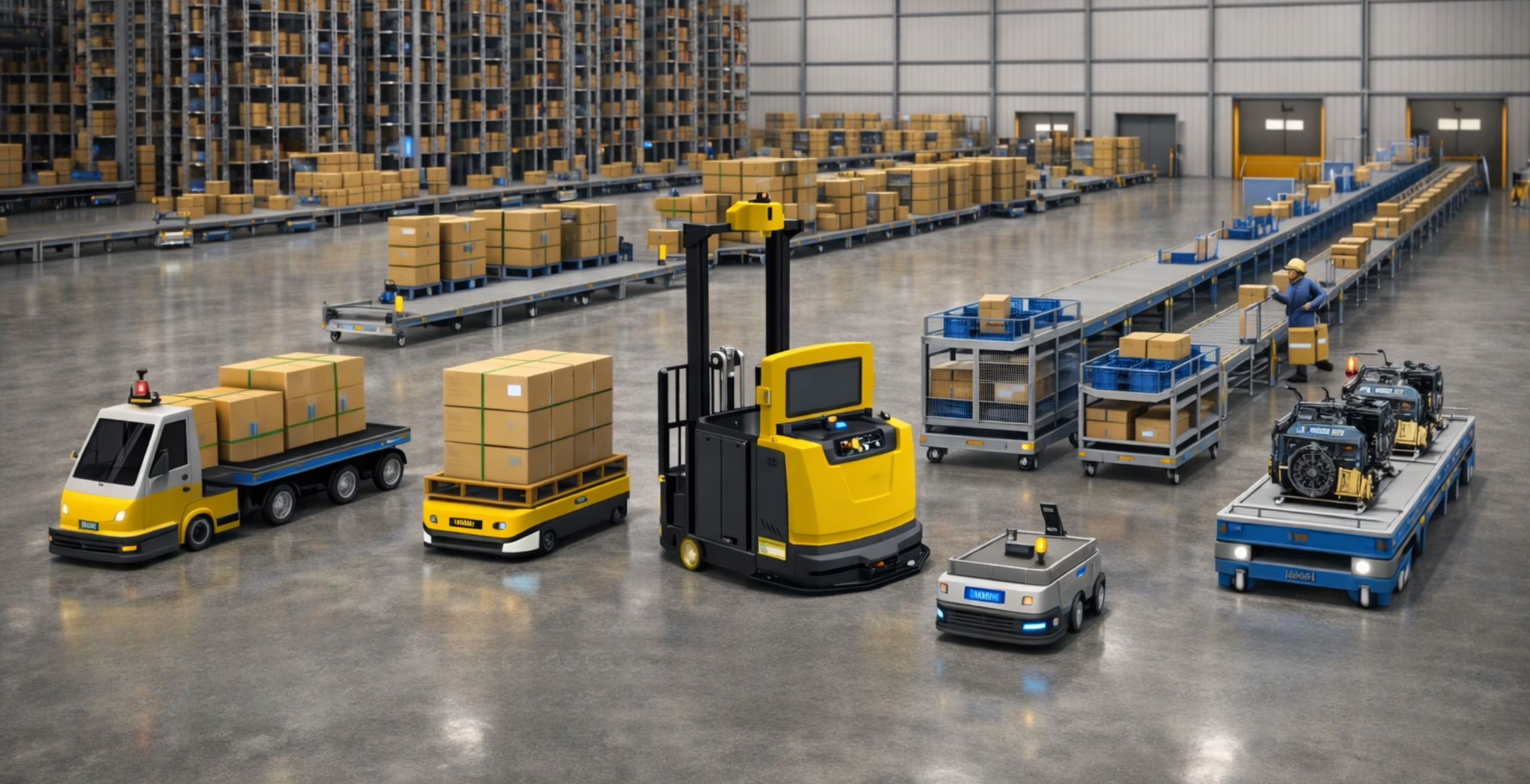
A tugger automated guided vehicle functions as an automated towing machine, pulling trains of carts or trailers along predetermined routes throughout facilities. The tugger vehicle itself is relatively compact, but its capability to haul multiple units simultaneously makes it highly efficient for moving substantial volumes across medium to long distances.
The system comprises the motorised tow vehicle equipped with guidance systems and an automated coupling mechanism, standardised carts or trailers designed for automated connection, and the guidance infrastructure (magnetic tape, wire, or laser reflectors) defining travel routes. Tugger AGVs typically incorporate sophisticated acceleration and braking control to prevent cart sway or load shifting, and include train configuration management that adjusts performance based on the number of carts being towed.
2
Unit Load AGV
×
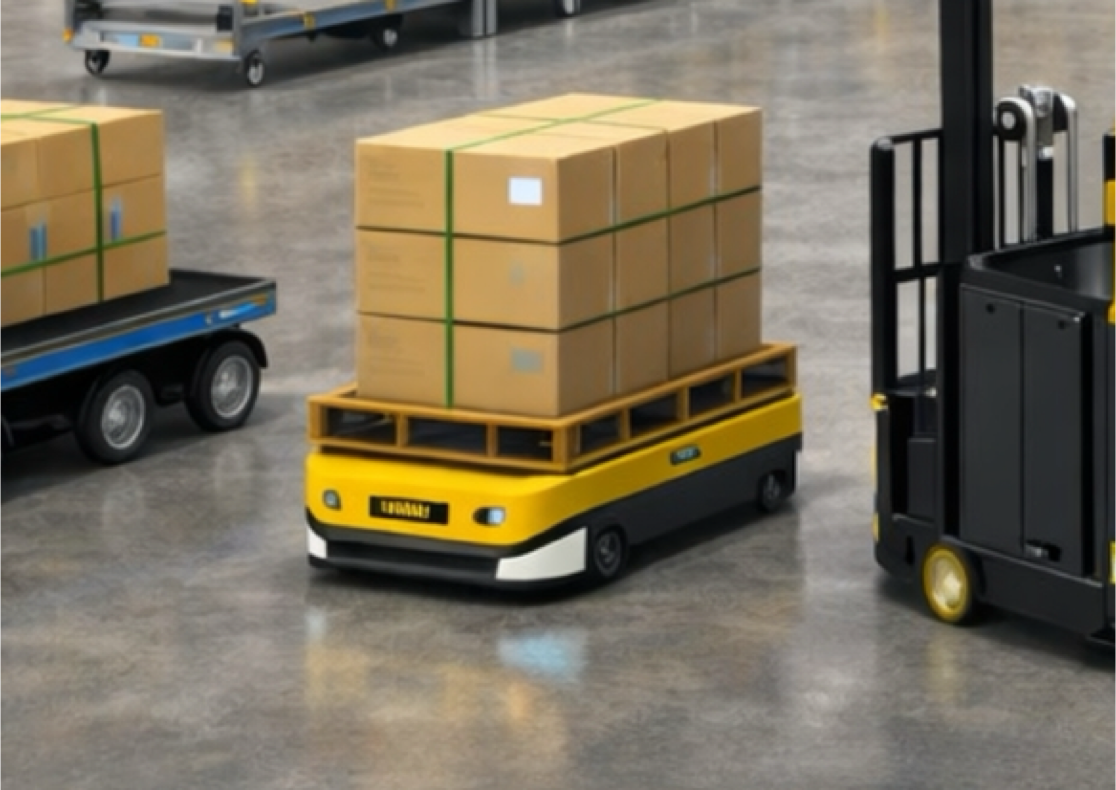
Unit Load AGV
Unit load AGVs transport individual loads, typically pallets, large bins, or industrial containers, without requiring separate carts or trailers. These AGV unit load carriers integrate the load-carrying surface directly into the vehicle, lifting loads slightly off the ground for transport and lowering them precisely at destinations.
The vehicle incorporates a load platform (often with integrated roller conveyors or chain transfers), lifting mechanisms to raise and lower loads, guidance systems, and transfer systems that enable autonomous loading and unloading without human assistance. Power systems typically use battery technology with opportunity or automated charging capabilities. AGV unit load carriers range from compact units handling 500kg to heavy-duty machines managing 3,000kg+ loads.
3
Forklift AGV
×
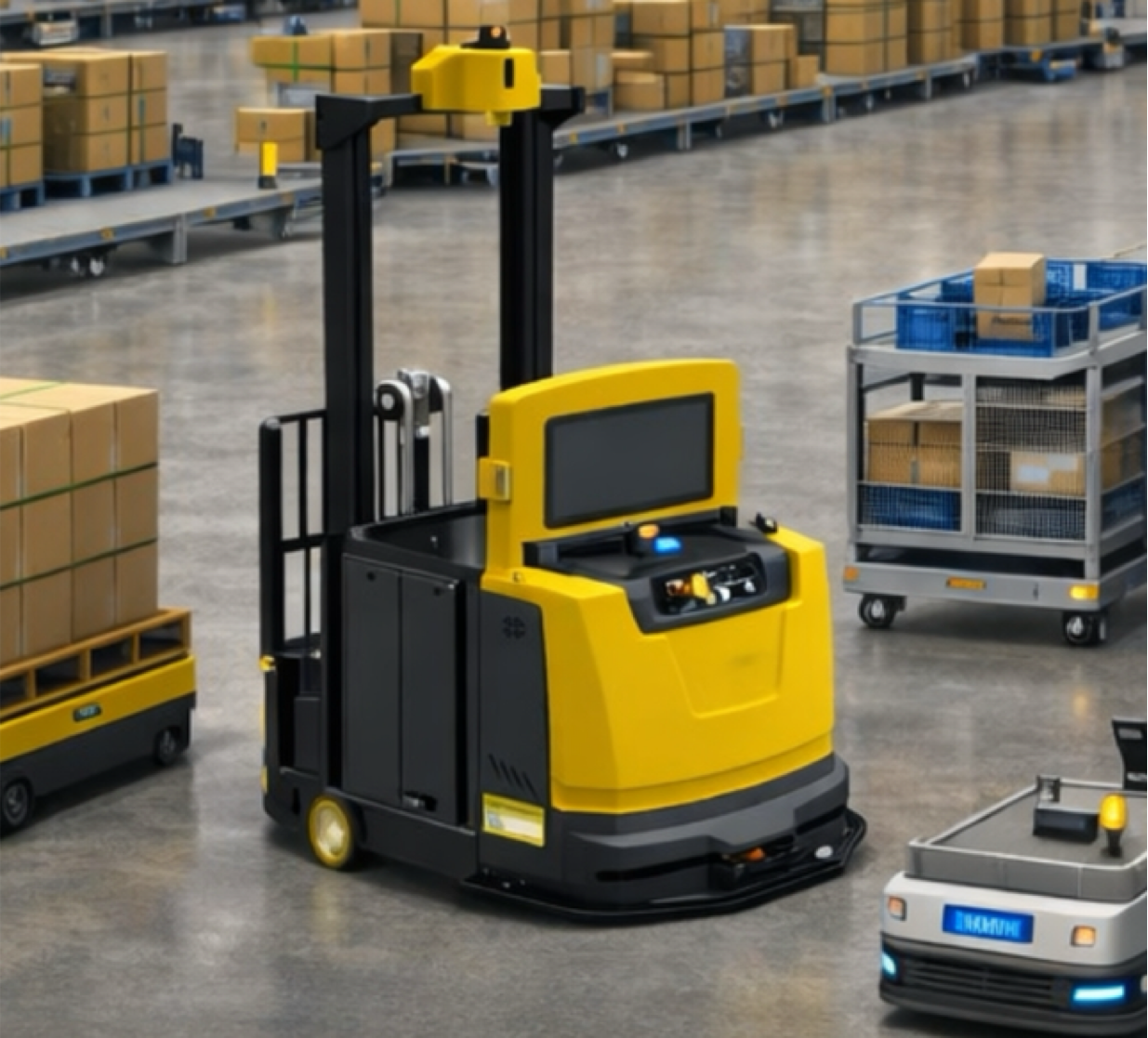
Forklift AGV
An automated forklift AGV replicates the capabilities of conventional forklifts whilst operating autonomously along defined routes. These machines lift loads from ground level, transport them to destinations, and position them at various heights, often interfacing with racking systems or elevated transfer points.
The automated forklift comprises a lift mast with fork carriage, drive and steering systems, guidance technology, sophisticated positioning sensors for precise fork placement, and comprehensive safety systems including approach detection and load monitoring. Some automated forklift systems incorporate laser guidance for narrow-aisle operation where precision is critical. Others use magnetic guidance in wider aisles where slightly less precision suffices.
4
Cart AGV
×
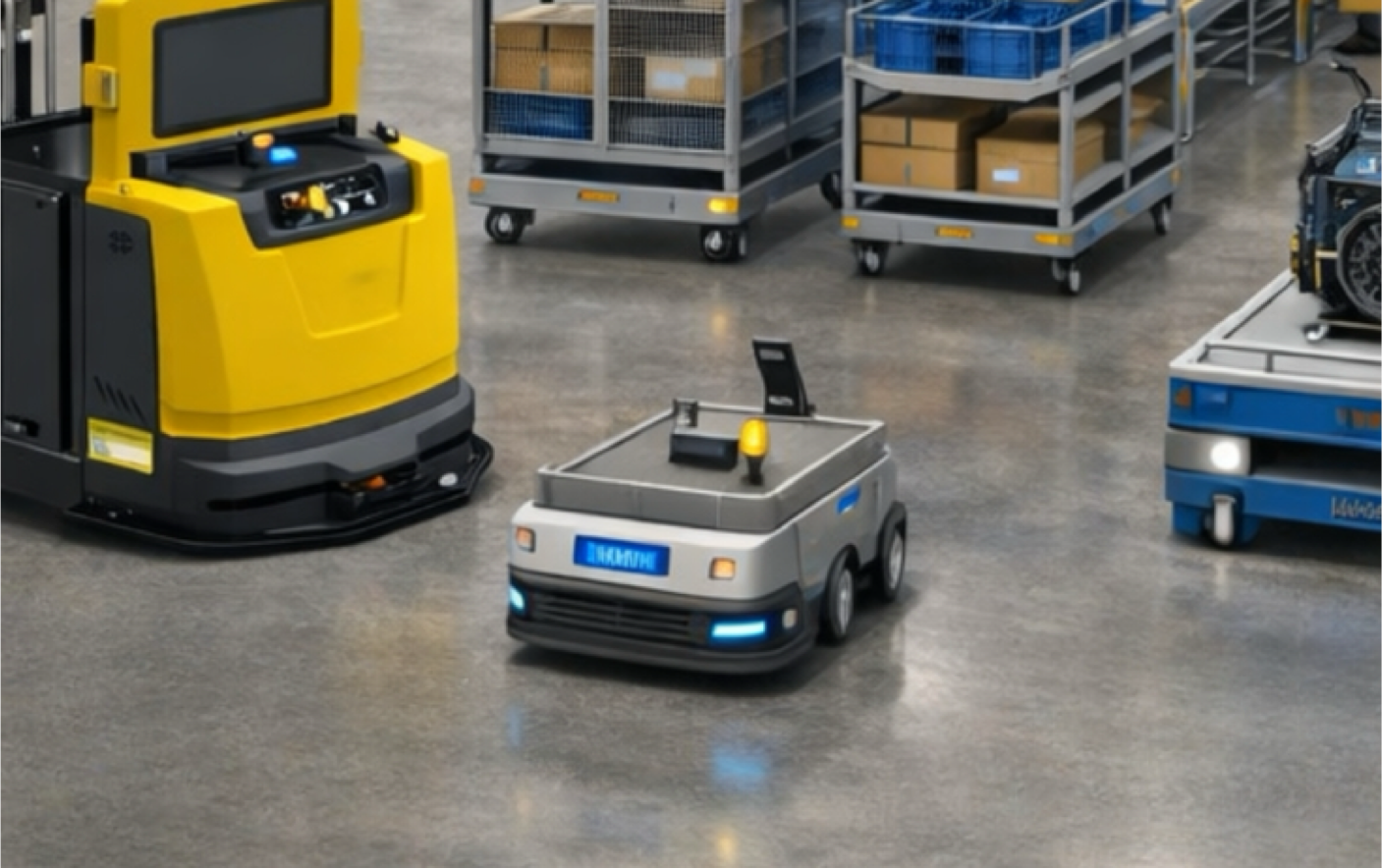
Cart AGV
Automated carts, sometimes called automated guided carts, are compact vehicles that carry loads on integrated platforms or in mounted bins. Unlike tugger AGVs that tow separate carts, these self-contained units carry goods directly, combining mobility with load capacity in a relatively small footprint.
An AGV cart typically features a low-profile platform for load stability, compact dimensions for manoeuvrability in tight spaces, lightweight construction that enables nimble movement, and guidance systems suitable for congested environments. Load capacities generally range from 50kg to 500kg, with platform sizes accommodating totes, bins, or small assemblies. Advanced models incorporate automated transfer mechanisms, conveyors, lifts, or pivoting platforms that enable autonomous loading and unloading.
5
Assembly Line AGV
×
Assembly Line AGV
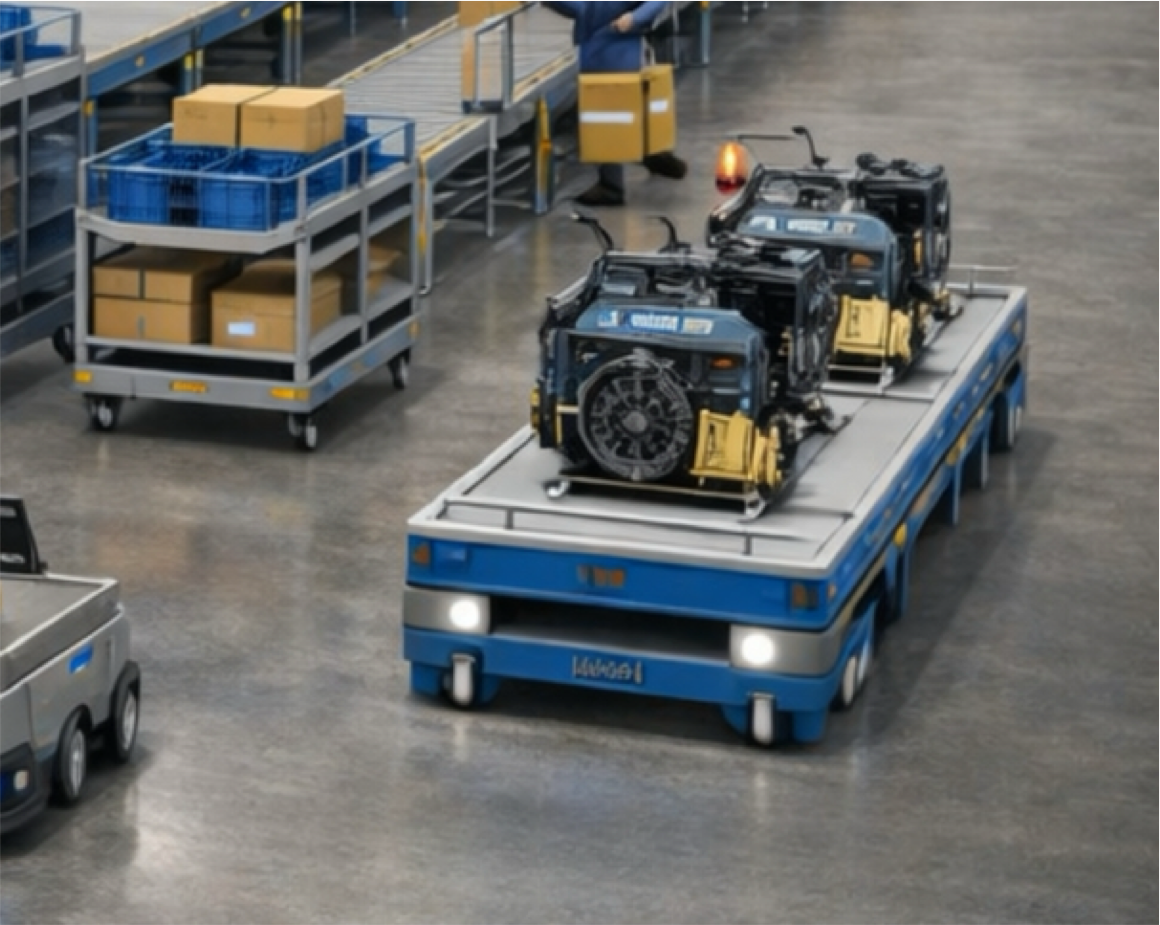
Assembly line vehicles are specialised AGVs designed to move work-in-process through manufacturing operations, essentially functioning as mobile assembly platforms. Unlike transport-focused AGVs, these AGV assembly line vehicles serve as workstations that progress through defined sequences, with workers or robots performing assembly operations at each station.
The vehicle incorporates a work platform sized for the product being assembled, power supplies for tools and equipment (compressed air, electricity), guidance systems following the assembly route, positioning systems ensuring precise stops at workstations, and often adjustable height platforms for ergonomic access. Some implementations include integrated tool arms or fixtures specific to the product family being manufactured. The AGV assembly line concept creates flexible manufacturing that can reconfigure quickly compared to fixed conveyor systems.
1
Tow/Tugger AGV
Tow/Tugger AGV
A tugger automated guided vehicle functions as an automated towing machine, pulling trains of carts or trailers along predetermined routes throughout facilities. The tugger vehicle itself is relatively compact, but its capability to haul multiple units simultaneously makes it highly efficient for moving substantial volumes across medium to long distances.
The system comprises the motorised tow vehicle equipped with guidance systems and an automated coupling mechanism, standardised carts or trailers designed for automated connection, and the guidance infrastructure (magnetic tape, wire, or laser reflectors) defining travel routes. Tugger AGVs typically incorporate sophisticated acceleration and braking control to prevent cart sway or load shifting, and include train configuration management that adjusts performance based on the number of carts being towed.
2
Unit Load AGV
Unit Load AGV
Unit load AGVs transport individual loads, typically pallets, large bins, or industrial containers, without requiring separate carts or trailers. These AGV unit load carriers integrate the load-carrying surface directly into the vehicle, lifting loads slightly off the ground for transport and lowering them precisely at destinations.
The vehicle incorporates a load platform (often with integrated roller conveyors or chain transfers), lifting mechanisms to raise and lower loads, guidance systems, and transfer systems that enable autonomous loading and unloading without human assistance. Power systems typically use battery technology with opportunity or automated charging capabilities. AGV unit load carriers range from compact units handling 500kg to heavy-duty machines managing 3,000kg+ loads.
3
Forklift AGV
Forklift AGV
An automated forklift AGV replicates the capabilities of conventional forklifts whilst operating autonomously along defined routes. These machines lift loads from ground level, transport them to destinations, and position them at various heights, often interfacing with racking systems or elevated transfer points.
The automated forklift comprises a lift mast with fork carriage, drive and steering systems, guidance technology, sophisticated positioning sensors for precise fork placement, and comprehensive safety systems including approach detection and load monitoring. Some automated forklift systems incorporate laser guidance for narrow-aisle operation where precision is critical. Others use magnetic guidance in wider aisles where slightly less precision suffices.
4
Cart AGV
Cart AGV
Automated carts, sometimes called automated guided carts, are compact vehicles that carry loads on integrated platforms or in mounted bins. Unlike tugger AGVs that tow separate carts, these self-contained units carry goods directly, combining mobility with load capacity in a relatively small footprint.
An AGV cart typically features a low-profile platform for load stability, compact dimensions for manoeuvrability in tight spaces, lightweight construction that enables nimble movement, and guidance systems suitable for congested environments. Load capacities generally range from 50kg to 500kg, with platform sizes accommodating totes, bins, or small assemblies. Advanced models incorporate automated transfer mechanisms, conveyors, lifts, or pivoting platforms that enable autonomous loading and unloading.
5
Assembly Line AGV
Assembly Line AGV
Assembly line vehicles are specialised AGVs designed to move work-in-process through manufacturing operations, essentially functioning as mobile assembly platforms. Unlike transport-focused AGVs, these AGV assembly line vehicles serve as workstations that progress through defined sequences, with workers or robots performing assembly operations at each station.
The vehicle incorporates a work platform sized for the product being assembled, power supplies for tools and equipment (compressed air, electricity), guidance systems following the assembly route, positioning systems ensuring precise stops at workstations, and often adjustable height platforms for ergonomic access. Some implementations include integrated tool arms or fixtures specific to the product family being manufactured. The AGV assembly line concept creates flexible manufacturing that can reconfigure quickly compared to fixed conveyor systems.
1
Pick-and-Place Arms
×
Pick-and-Place Arms
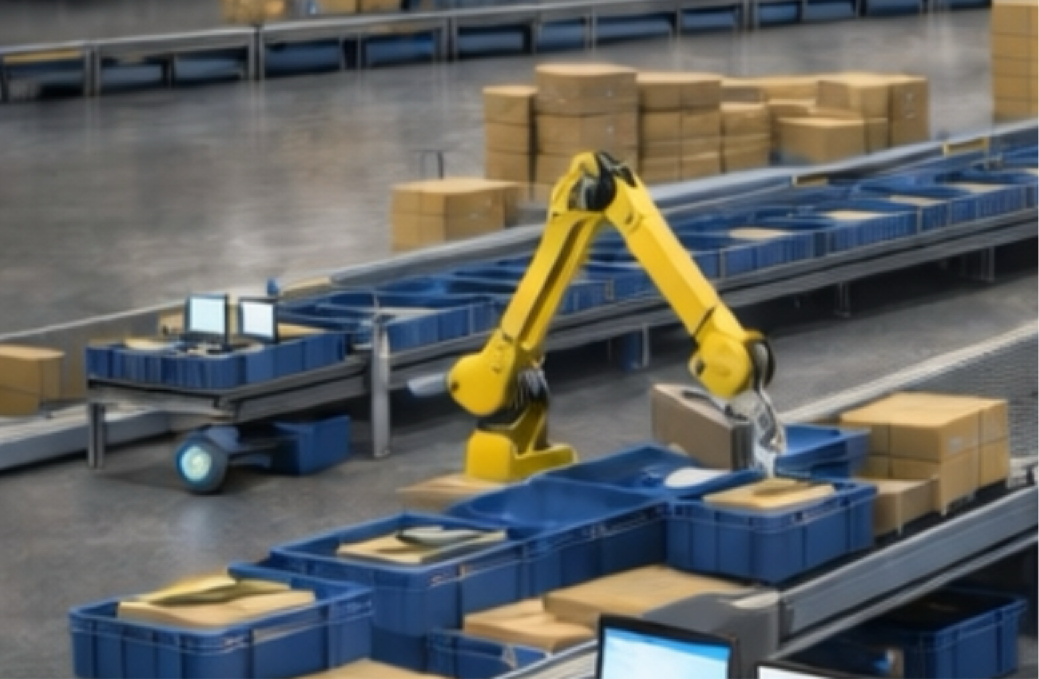
Pick and place robotic arms specialise in moving items from one location to another, selecting products from bins or conveyors and positioning them precisely in packaging, onto pallets, or into assembly fixtures. These systems combine speed with precision, handling anywhere from 30 to 120+ picks per minute, depending on item characteristics, travel distances, and placement accuracy requirements.
The system comprises a multi-axis robot arm (typically 4-6 axes) providing the range of motion required for the application, end-effectors customised for the specific items being handled (vacuum grippers for boxes, mechanical grippers for irregular items, magnetic grippers for ferrous components), vision systems identifying item locations and orientations, and control systems managing pick sequences and coordinating with upstream and downstream equipment. Advanced implementations incorporate force sensing for the gentle handling of fragile items and adaptive gripping that adjusts to product variability.
2
Palletising Arms
×
Palletising Arms
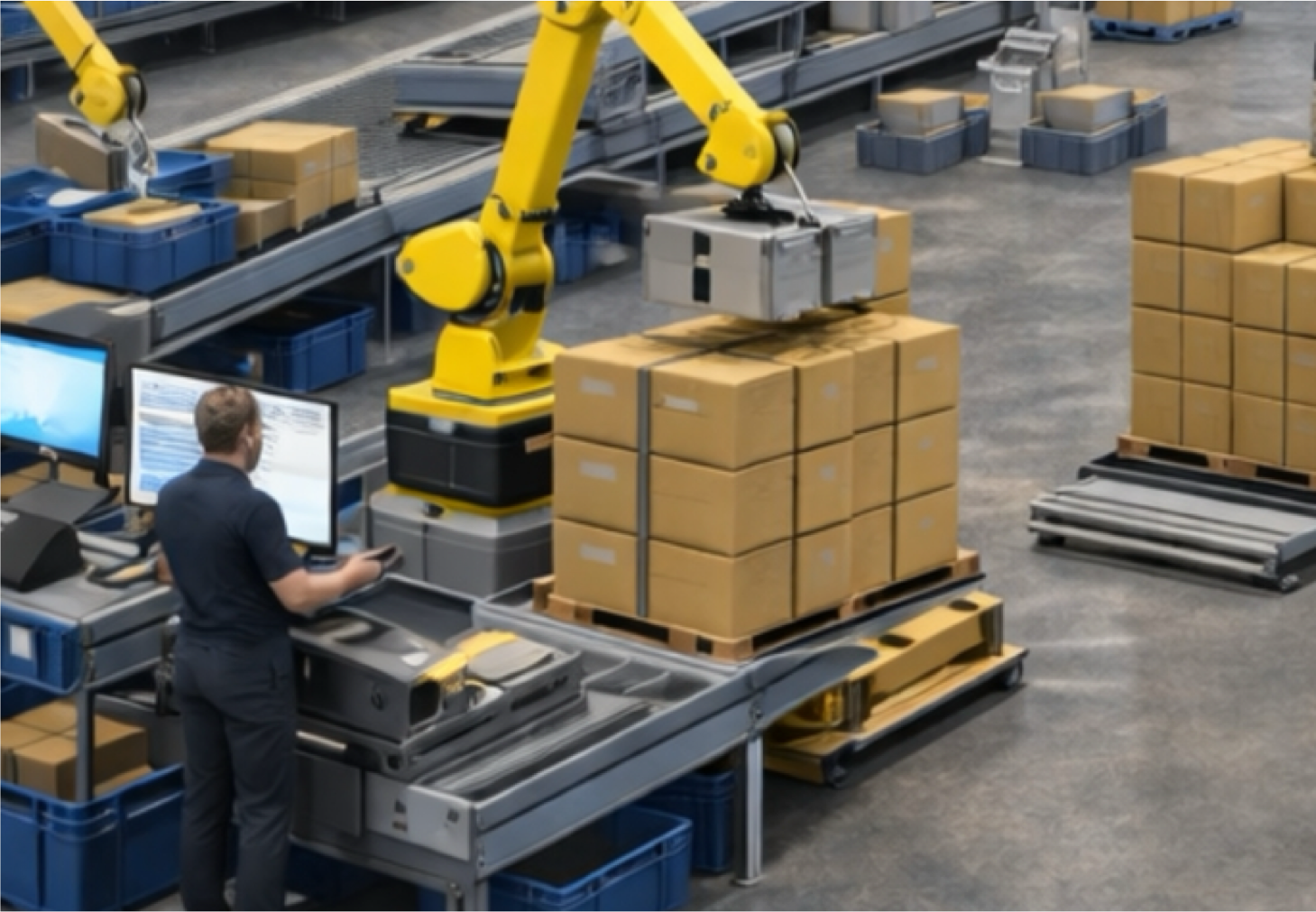
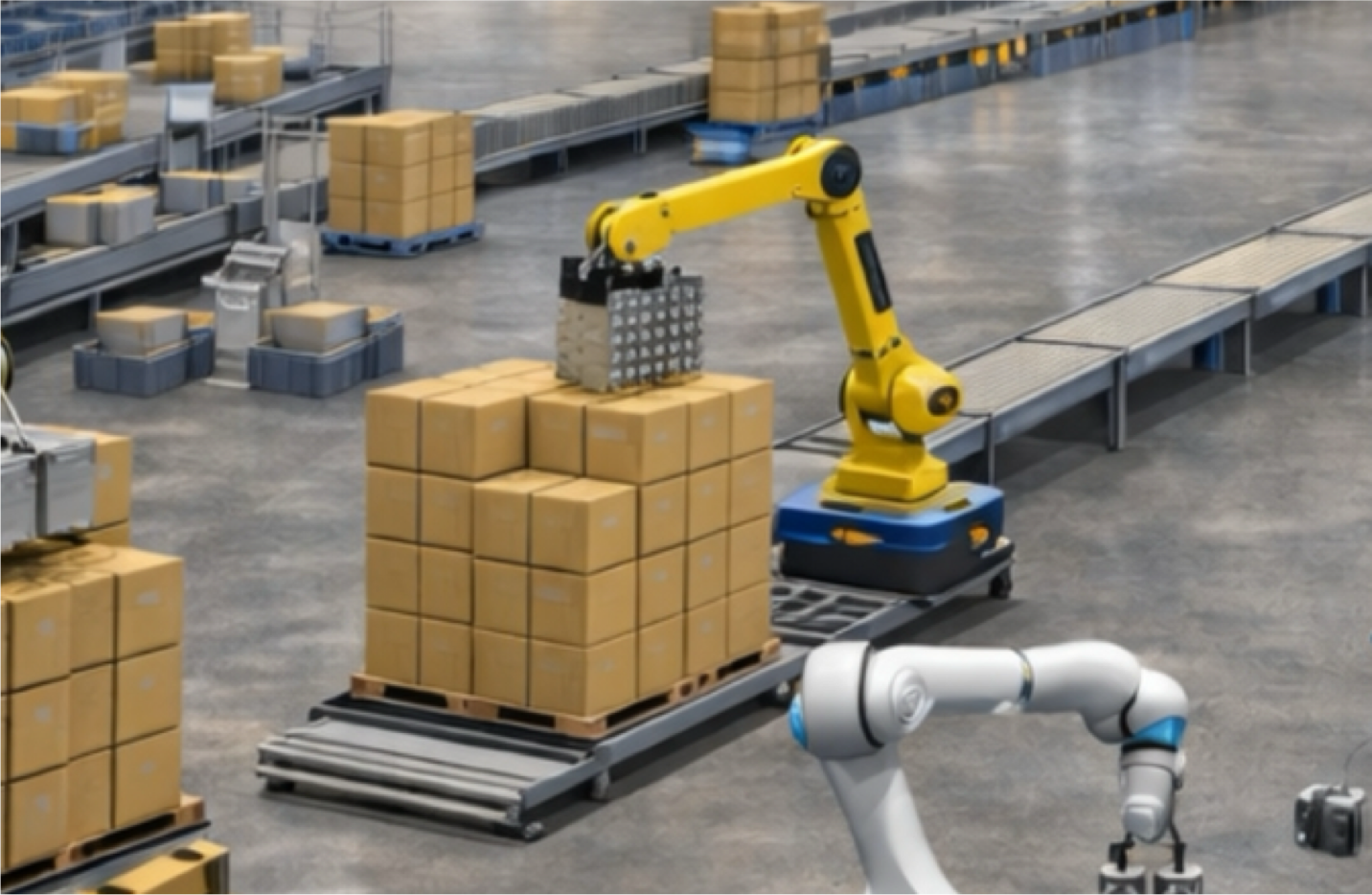
Palletising robots automate the stacking of cases, bags, or products onto pallets in predetermined patterns, eliminating the physically demanding manual palletising that causes significant workplace injuries. These robot palletising systems handle loads from 1kg to 50kg+, stacking to heights of 2+ metres with precision that ensures stable pallets suitable for transport and storage.
The system comprises a heavy-duty robot arm (typically 4-5 axes with high payload capacity), specialised end-effectors (often layer grippers handling multiple cases simultaneously or vacuum systems for individual case handling), pallet dispensers and conveyors supplying empty pallets, product infeed conveyors delivering items to be palletised, and control systems managing layer patterns, pallet construction sequences, and coordination with pallet removal systems. Advanced implementations incorporate vision systems verifying case positioning and quality checks, ensuring only acceptable products reach pallets.
3
Depalletizing Arms
×
Depalletizing Arms
Depalletizing robots reverse the palletising process, automatically removing cases, bags, or products from incoming pallets and placing them onto conveyors or transfer systems for downstream processing. A robot depalletizer handles the physically demanding and sometimes hazardous task of breaking down loaded pallets, enabling automated processing of incoming goods.
The system comprises a robot arm (typically medium to heavy payload capacity), vision systems identifying case positions and orientations on mixed pallets, end-effectors designed for reliable gripping of diverse packaging types, pallet conveyors delivering loaded pallets to the robot, product discharge conveyors receiving depalletised items, and control systems managing the depalletising sequence, empty pallet removal, and coordination with downstream processes.
4
Collaborative Robots
×
Collaborative Robots
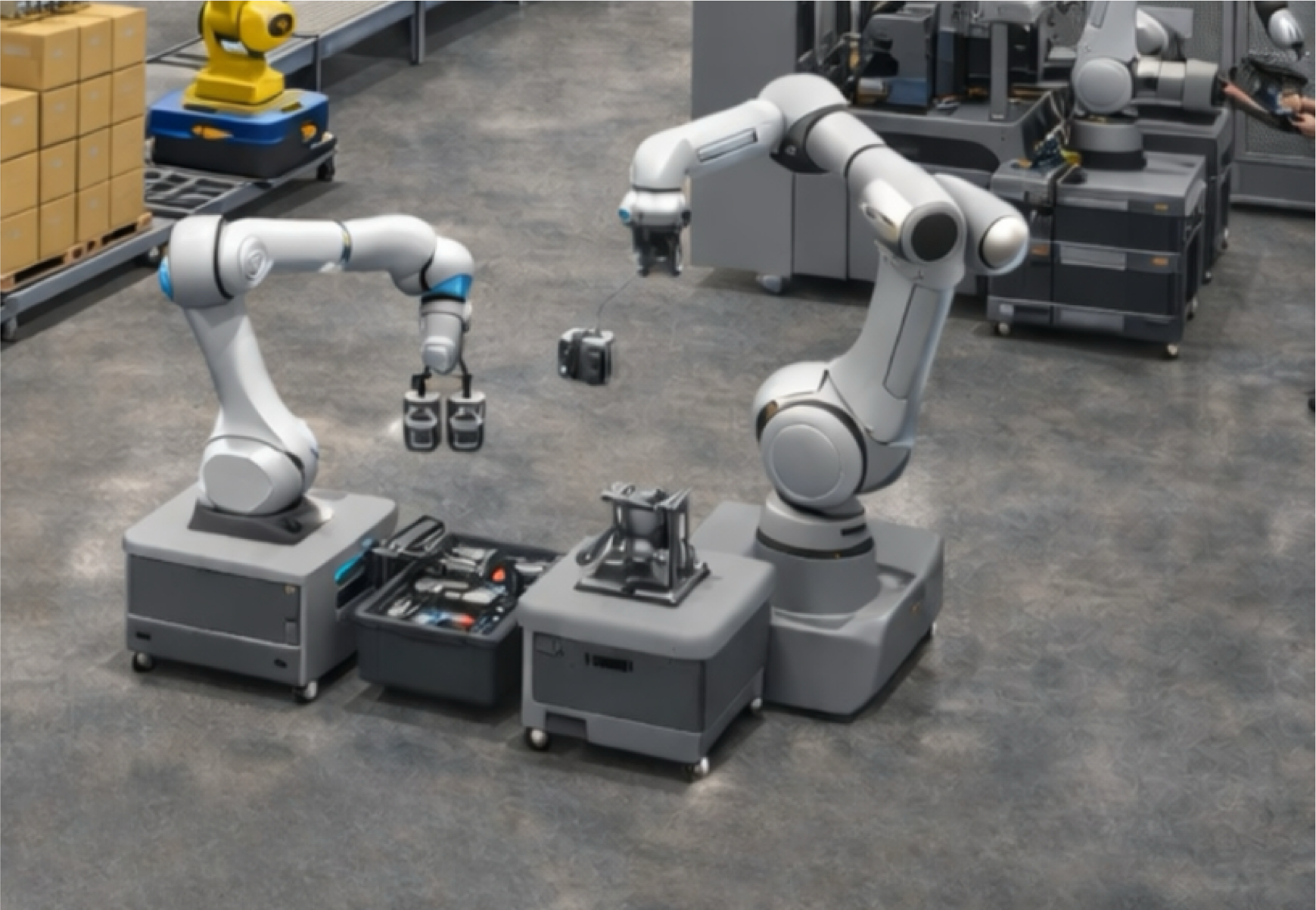
Collaborative robot cobot designs specifically enable safe operation alongside human workers without requiring safety caging or extensive guarding. These cobot collaborative robot systems incorporate force-limiting technology, rounded profiles eliminating pinch points, and sophisticated sensing that stops movement immediately upon detecting contact with a person.
A collaborative robots implementation comprises the robot arm itself (typically 6-axis designs with payload capacities from 3kg to 35kg), force and torque sensors at each joint detecting contact or resistance, intuitive programming interfaces (often hand-guided teaching where operators physically move the arm through desired paths), modular end-effectors suited for diverse applications, and safety systems certified for collaborative operation. Vision systems often integrate with cobots to enable adaptive tasks like random bin picking or quality inspection.
5
Machine Tending Arms
×
Machine Tending Arms
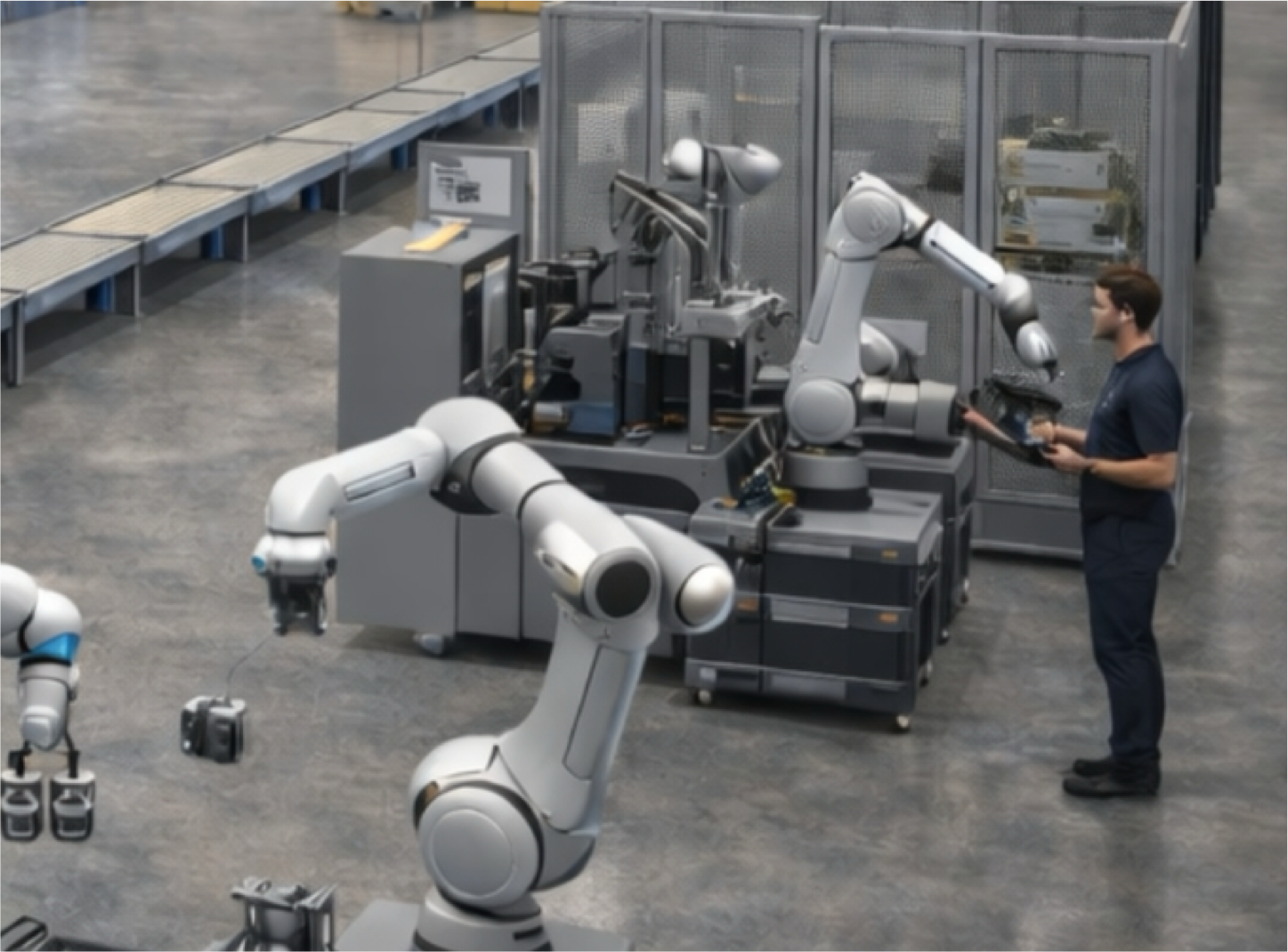
Machine tending robots automate the loading and unloading of production equipment, CNC machines, injection moulding presses, stamping operations, or other manufacturing equipment requiring workpiece handling between cycles. Robotic machine tending eliminates the need for dedicated operators attending machinery, enabling lights-out manufacturing or allowing operators to oversee multiple machines simultaneously.
The system comprises a robot arm matched to the specific machine’s requirements (payload capacity, reach, and speed aligned with cycle times and part characteristics), end-effectors designed for the specific workpieces being handled, machine interface systems coordinating robot actions with equipment cycles, part feeding systems (conveyors, bins, or hoppers) supplying raw materials, finished part removal systems, and control systems managing the complete cell operation. Safety systems ensure proper coordination, preventing robot and machine interference.
1
Pick-and-Place Arms
Pick-and-Place Arms
Pick and place robotic arms specialise in moving items from one location to another, selecting products from bins or conveyors and positioning them precisely in packaging, onto pallets, or into assembly fixtures. These systems combine speed with precision, handling anywhere from 30 to 120+ picks per minute, depending on item characteristics, travel distances, and placement accuracy requirements.
The system comprises a multi-axis robot arm (typically 4-6 axes) providing the range of motion required for the application, end-effectors customised for the specific items being handled (vacuum grippers for boxes, mechanical grippers for irregular items, magnetic grippers for ferrous components), vision systems identifying item locations and orientations, and control systems managing pick sequences and coordinating with upstream and downstream equipment. Advanced implementations incorporate force sensing for the gentle handling of fragile items and adaptive gripping that adjusts to product variability.
2
Palletising Arms
Palletising Arms
Palletising robots automate the stacking of cases, bags, or products onto pallets in predetermined patterns, eliminating the physically demanding manual palletising that causes significant workplace injuries. These robot palletising systems handle loads from 1kg to 50kg+, stacking to heights of 2+ metres with precision that ensures stable pallets suitable for transport and storage.
The system comprises a heavy-duty robot arm (typically 4-5 axes with high payload capacity), specialised end-effectors (often layer grippers handling multiple cases simultaneously or vacuum systems for individual case handling), pallet dispensers and conveyors supplying empty pallets, product infeed conveyors delivering items to be palletised, and control systems managing layer patterns, pallet construction sequences, and coordination with pallet removal systems. Advanced implementations incorporate vision systems verifying case positioning and quality checks, ensuring only acceptable products reach pallets.
3
Depalletizing Arms
Depalletizing Arms
Depalletizing robots reverse the palletising process, automatically removing cases, bags, or products from incoming pallets and placing them onto conveyors or transfer systems for downstream processing. A robot depalletizer handles the physically demanding and sometimes hazardous task of breaking down loaded pallets, enabling automated processing of incoming goods.
The system comprises a robot arm (typically medium to heavy payload capacity), vision systems identifying case positions and orientations on mixed pallets, end-effectors designed for reliable gripping of diverse packaging types, pallet conveyors delivering loaded pallets to the robot, product discharge conveyors receiving depalletised items, and control systems managing the depalletising sequence, empty pallet removal, and coordination with downstream processes.
4
Collaborative Robots
Collaborative Robots
Collaborative robot cobot designs specifically enable safe operation alongside human workers without requiring safety caging or extensive guarding. These cobot collaborative robot systems incorporate force-limiting technology, rounded profiles eliminating pinch points, and sophisticated sensing that stops movement immediately upon detecting contact with a person.
A collaborative robots implementation comprises the robot arm itself (typically 6-axis designs with payload capacities from 3kg to 35kg), force and torque sensors at each joint detecting contact or resistance, intuitive programming interfaces (often hand-guided teaching where operators physically move the arm through desired paths), modular end-effectors suited for diverse applications, and safety systems certified for collaborative operation. Vision systems often integrate with cobots to enable adaptive tasks like random bin picking or quality inspection.
5
Machine Tending Arms
Machine Tending Arms
Machine tending robots automate the loading and unloading of production equipment, CNC machines, injection moulding presses, stamping operations, or other manufacturing equipment requiring workpiece handling between cycles. Robotic machine tending eliminates the need for dedicated operators attending machinery, enabling lights-out manufacturing or allowing operators to oversee multiple machines simultaneously.
The system comprises a robot arm matched to the specific machine’s requirements (payload capacity, reach, and speed aligned with cycle times and part characteristics), end-effectors designed for the specific workpieces being handled, machine interface systems coordinating robot actions with equipment cycles, part feeding systems (conveyors, bins, or hoppers) supplying raw materials, finished part removal systems, and control systems managing the complete cell operation. Safety systems ensure proper coordination, preventing robot and machine interference.
1
Goods-to-Person AMR
×
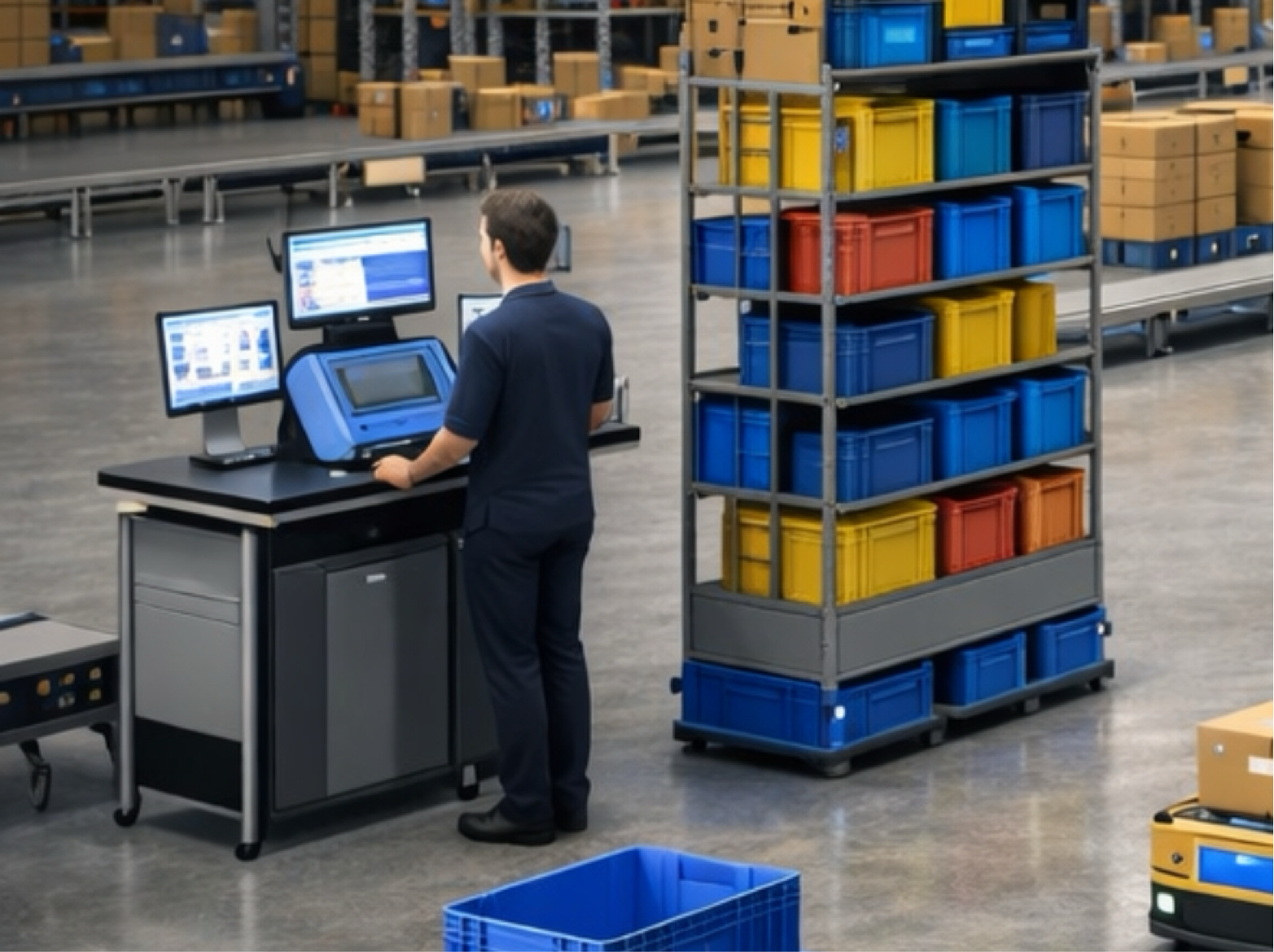
Goods-to-Person AMR
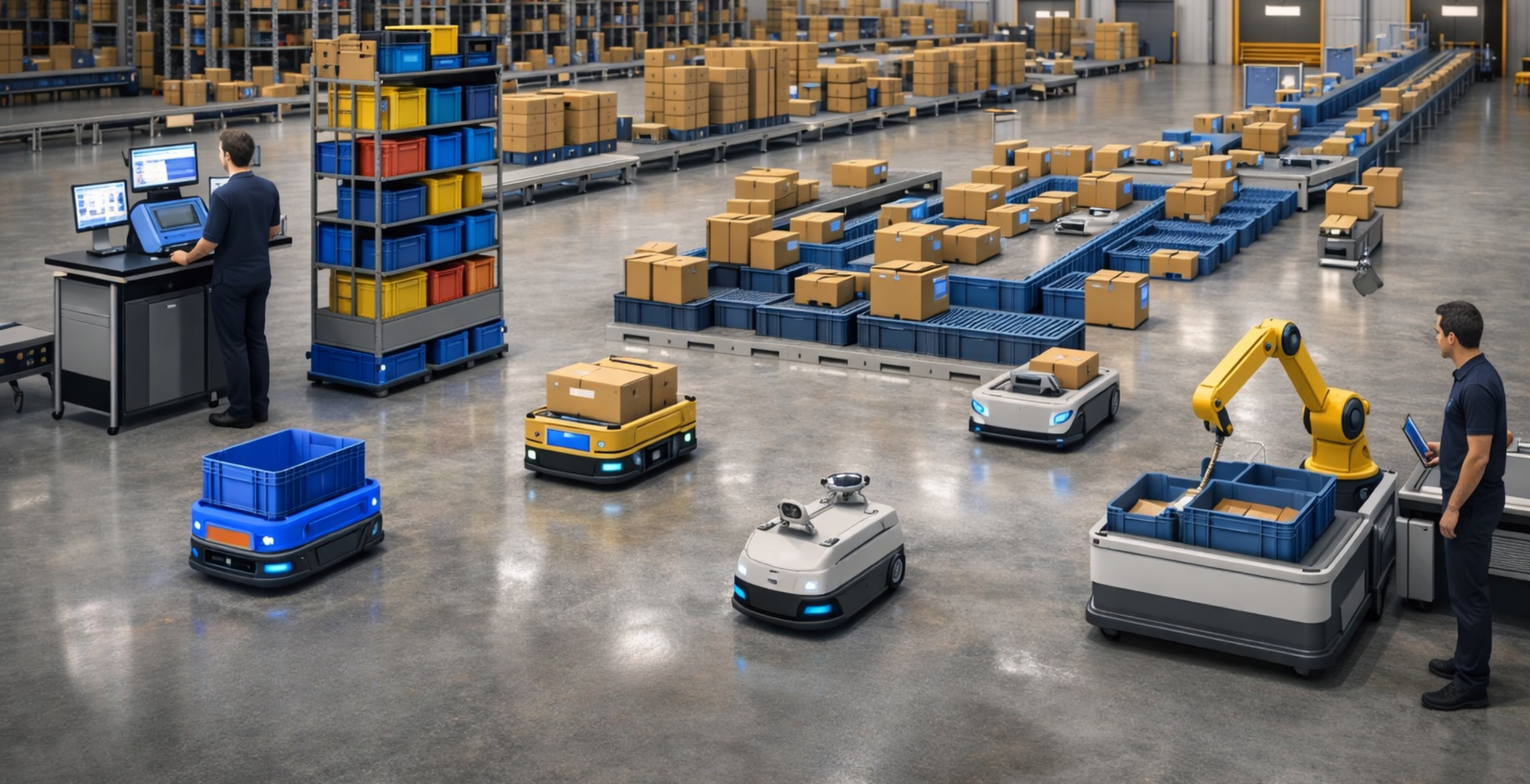
Goods to person automation represents a fundamental shift from traditional “person-to-goods” picking. These robots travel beneath portable racking units, lift entire shelving sections, and transport them to ergonomic picking stations where operators select required items. After picking is complete, the goods to person AMR returns the inventory to its storage location and retrieves the next required unit.
The system comprises the mobile robots themselves (typically capable of lifting 500-1,500kg), portable racking designed for robot access, picking workstations with put walls or conveyor integration, and fleet management software that optimises which inventory to retrieve and in what sequence. Advanced implementations use predictive algorithms to pre-stage inventory near stations before orders arrive, further reducing wait times.
2
Inventory Transport AMR
×
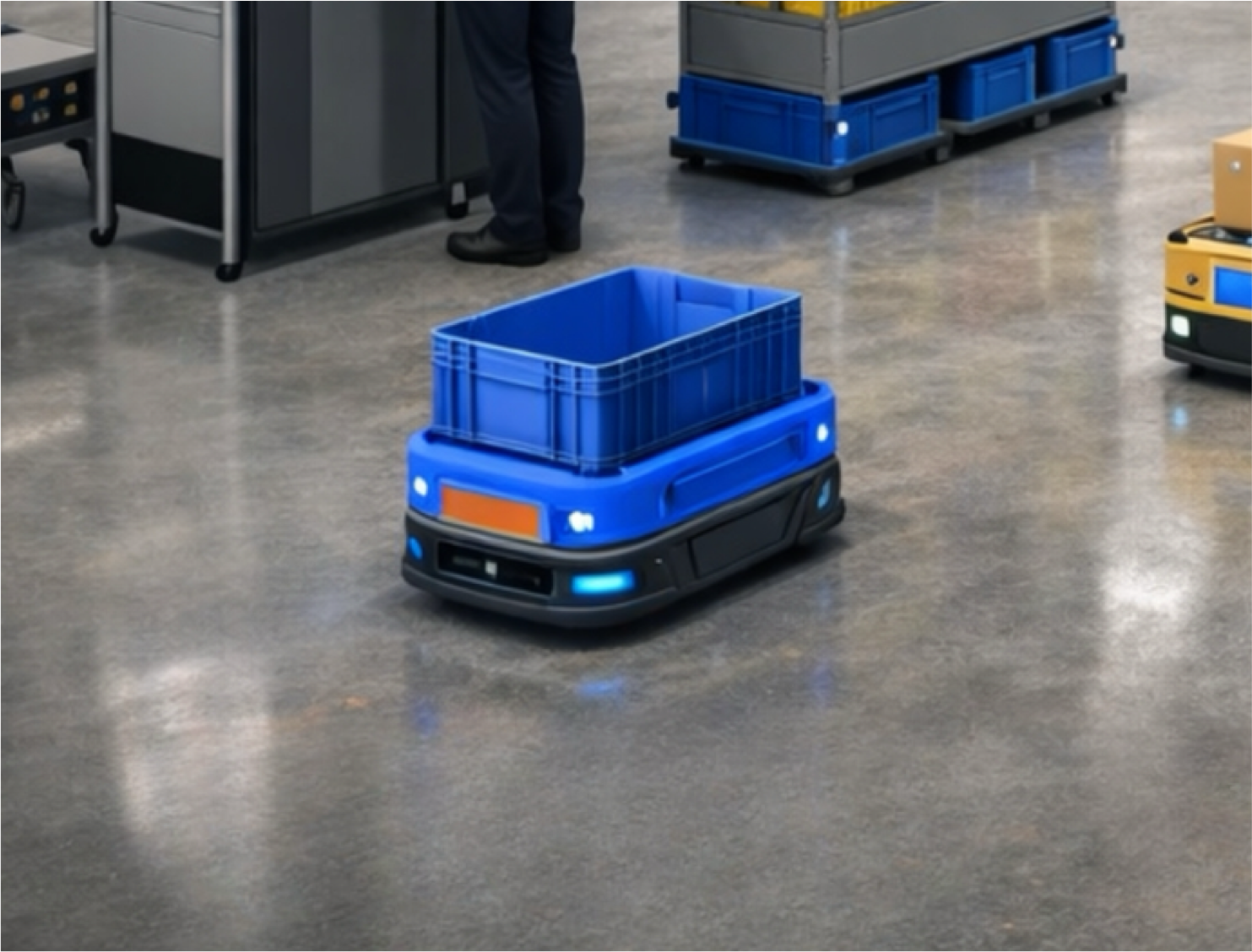
Inventory Transport AMR
These automated warehouse robots serve as autonomous material handlers, moving pallets, carts, totes, or bins between designated locations throughout the facility. They function essentially as intelligent, tireless tuggers that navigate independently, queuing for lifts, negotiating intersections, and adjusting routes based on real-time conditions.
The robots feature various load-handling mechanisms depending on application: some lift and carry loads directly, others tow carts or trolleys, whilst pallet-handling variants use fork mechanisms or conveyor tops to transport standard pallets. Navigation relies on natural feature recognition rather than floor markers, allowing operation in dynamic environments. Wireless charging systems enable 24/7 operation, with robots automatically docking for opportunity charging between tasks.
3
Sorting AMR
×
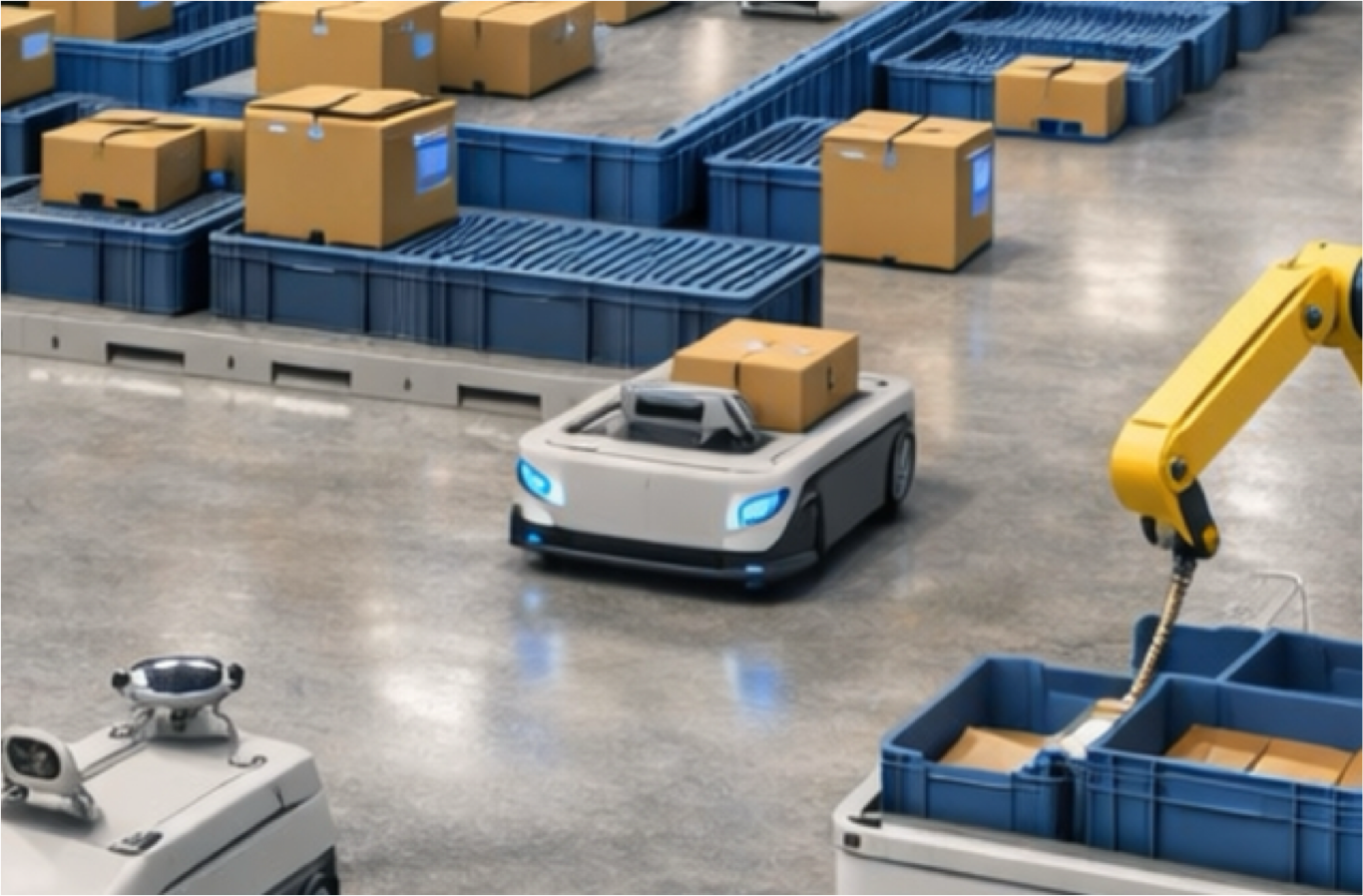
Sorting AMR
Sorting robots automate the distribution of items to multiple destinations, eliminating manual sortation processes. These machines travel across the facility floor, scanning packages or parcels to determine destination, then depositing items into designated chutes, bins, or zones. The approach differs fundamentally from fixed sortation conveyors by providing flexibility and requiring minimal infrastructure.
A pallet sorting robot variant handles larger loads, directing full pallets to appropriate shipping lanes or storage zones based on destination, customer, or routing requirements. The robots incorporate barcode or RFID scanning capabilities, routing logic, and precise positioning systems that ensure accurate placement even at high speeds.
4
Inspection/Mapping AMR
×
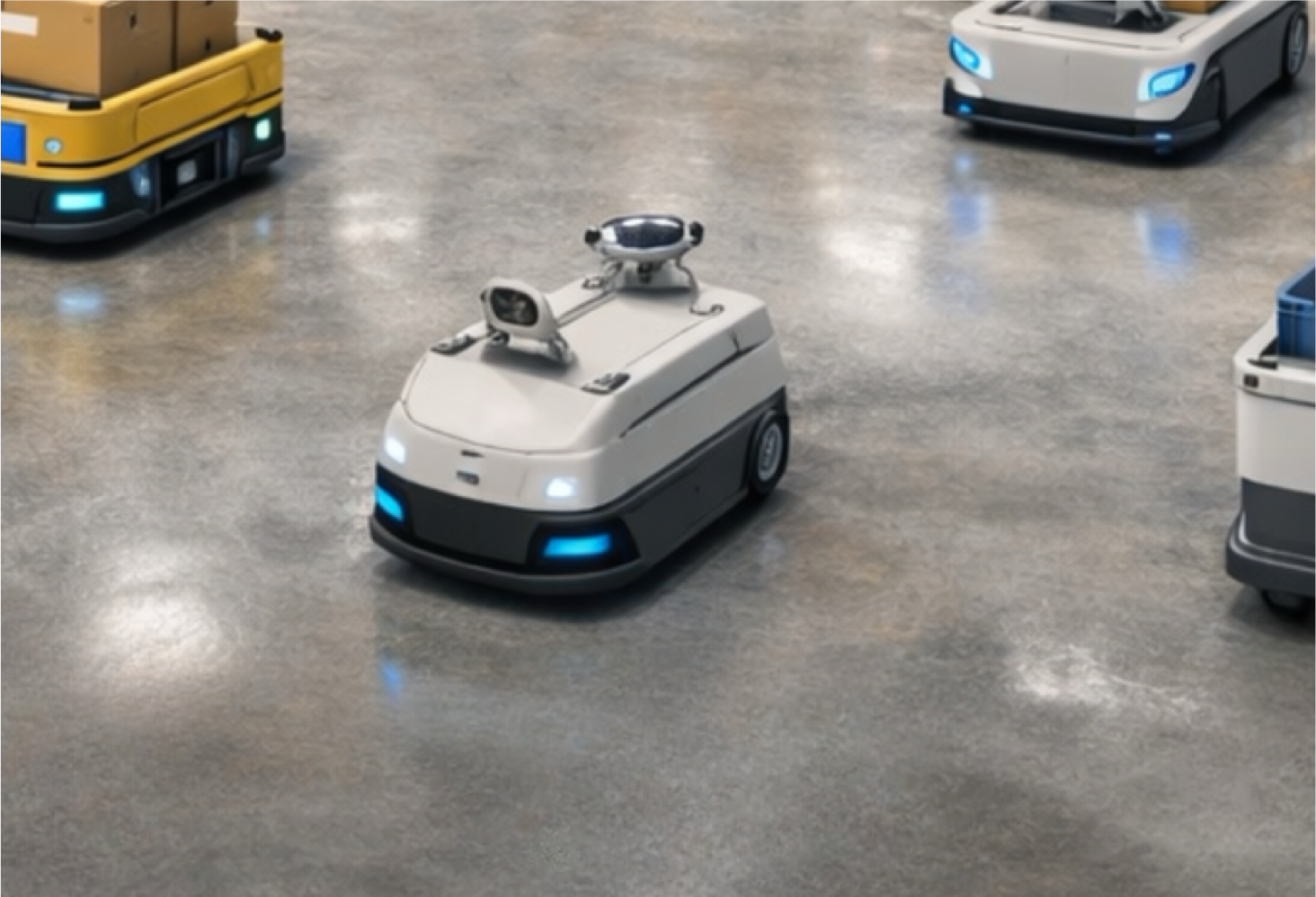
Inspection/Mapping AMR
These specialised autonomous mobile robots conduct systematic facility surveys, capturing inventory locations, verifying stockkeeping accuracy, and identifying exceptions. Equipped with high-resolution cameras, RFID readers, and sophisticated computer vision, they navigate aisles documenting inventory positions and reading identification tags or labels.
The technology combines navigation systems that enable precise route following with data capture capabilities, cameras photographing racking faces, RFID antennas query tagged items, and barcode scanners read labels. Post-processing software compares captured data against inventory management systems, flagging discrepancies and generating exception reports that direct human investigation.
5
Conveyor-Top AMR
×
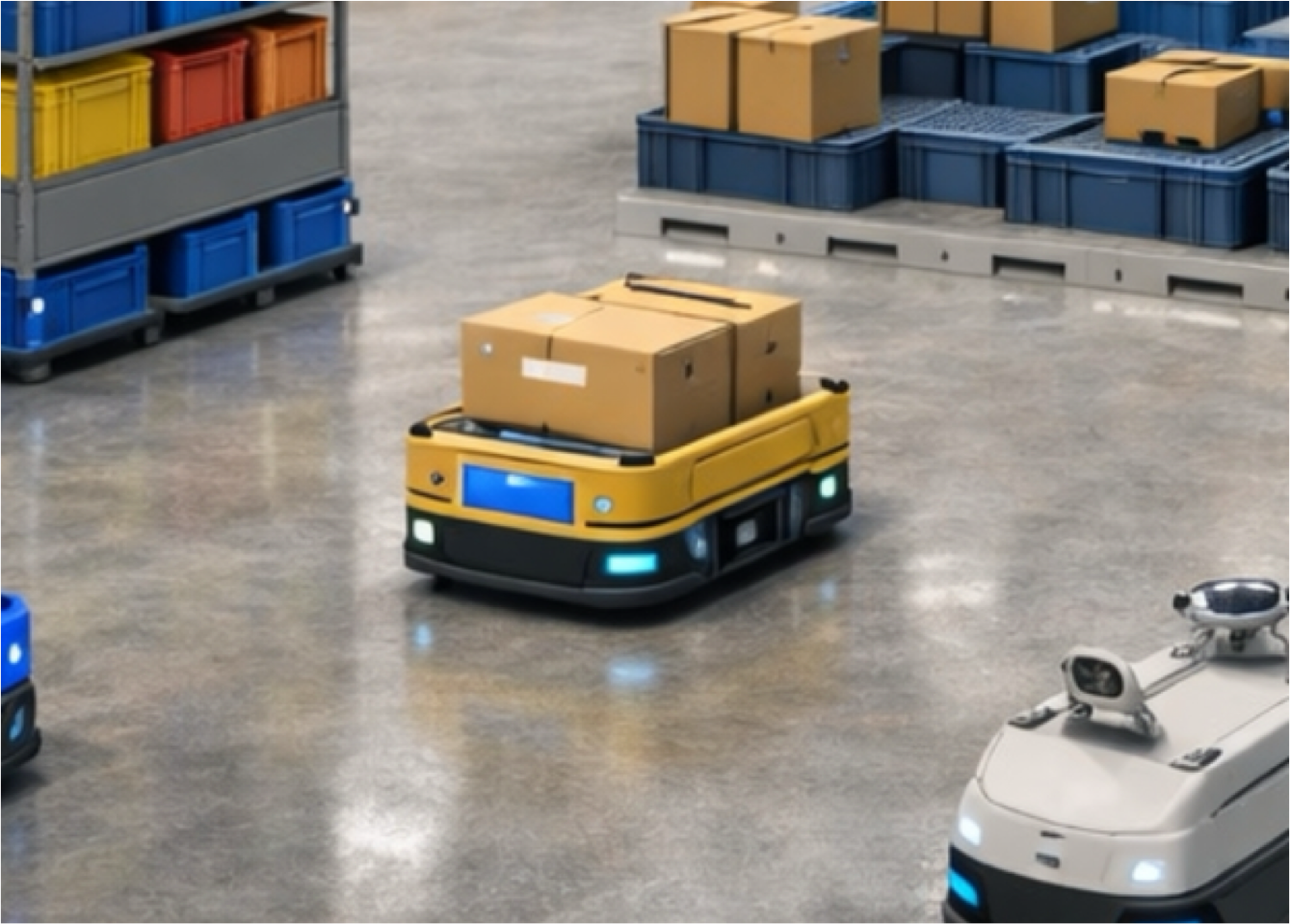
Conveyor-Top AMR
These robots operate on existing conveyor systems, functioning as intelligent, movable sorting divert points. Rather than installing extensive fixed sortation infrastructure, conveyor-top AMRs travel along conveyors, identify items requiring diversion to specific destinations, and push or guide those items off the main line at appropriate points.
The robots mount directly onto conveyor frames, moving upstream and downstream as needed. Sensors identify approaching items, onboard logic determines whether diversion is required, and mechanical actuators push items off the conveyor at precise moments. Fleet management software orchestrates multiple robots, positioning them optimally to handle the current order mix.
6
Picking AMR
×
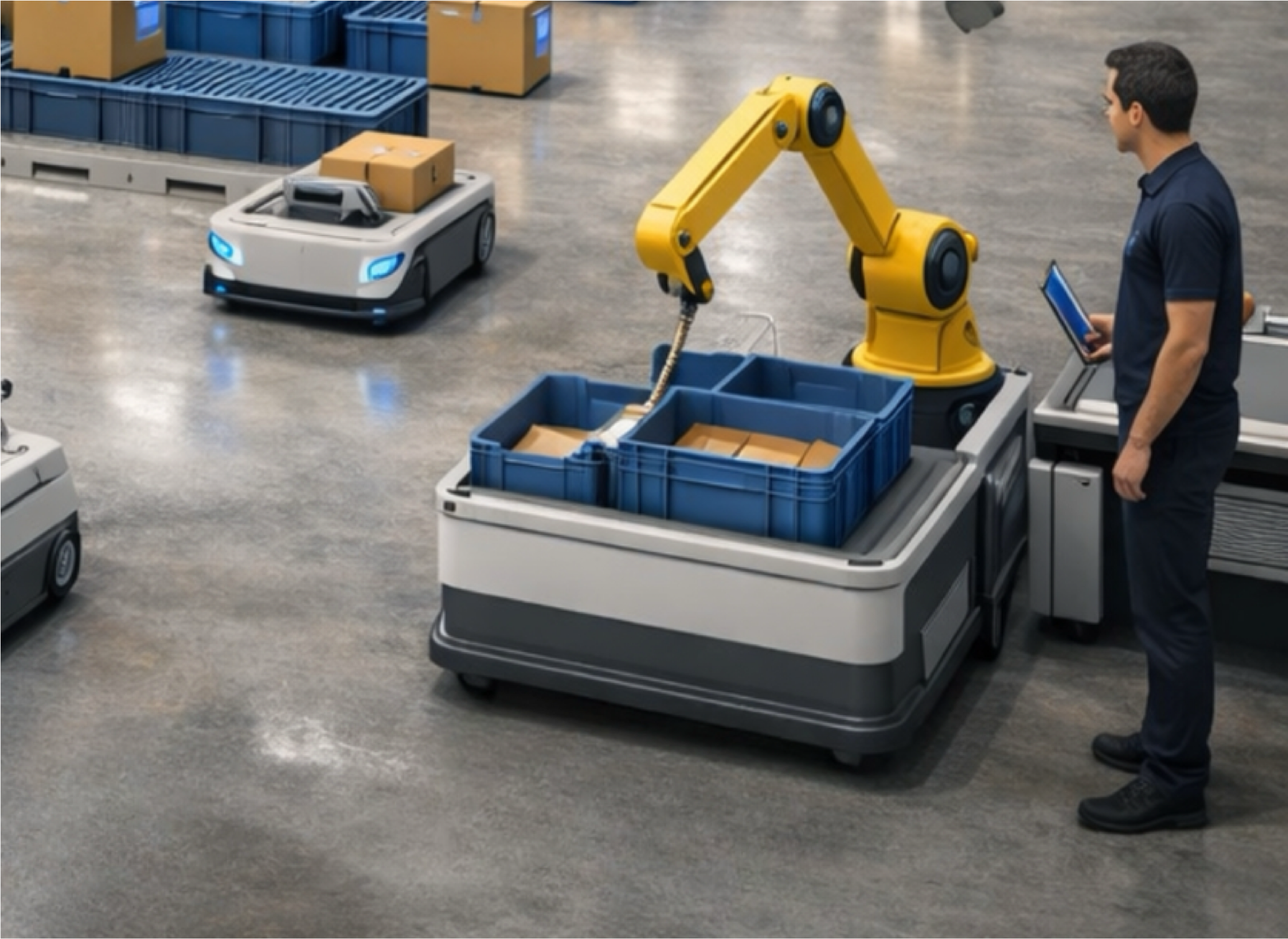
Picking AMR
Automated warehouse picking robots work collaboratively with human operators, combining human dexterity and decision-making with robotic mobility and data management. These AMRs travel to storage locations alongside workers, presenting picking instructions on integrated displays, verifying selections through scanning, and carrying totes or bins to accumulate picks. Some advanced systems incorporate robotic arms for automated item selection, though collaborative picking remains more common for diverse inventory.
The robots feature intuitive displays showing pick quantities and locations, integrated barcode scanners for verification, compartmentalised storage for multi-order picking, and navigation systems that guide operators along optimal paths. Fleet software assigns orders to robots based on inventory locations, operator positions, and picking priorities, orchestrating dozens of picking sessions simultaneously.
1
Goods-to-Person AMR
Goods-to-Person AMR
Goods to person automation represents a fundamental shift from traditional “person-to-goods” picking. These robots travel beneath portable racking units, lift entire shelving sections, and transport them to ergonomic picking stations where operators select required items. After picking is complete, the goods to person AMR returns the inventory to its storage location and retrieves the next required unit.
The system comprises the mobile robots themselves (typically capable of lifting 500-1,500kg), portable racking designed for robot access, picking workstations with put walls or conveyor integration, and fleet management software that optimises which inventory to retrieve and in what sequence. Advanced implementations use predictive algorithms to pre-stage inventory near stations before orders arrive, further reducing wait times.
2
Inventory Transport AMR
Inventory Transport AMR
These automated warehouse robots serve as autonomous material handlers, moving pallets, carts, totes, or bins between designated locations throughout the facility. They function essentially as intelligent, tireless tuggers that navigate independently, queuing for lifts, negotiating intersections, and adjusting routes based on real-time conditions.
The robots feature various load-handling mechanisms depending on application: some lift and carry loads directly, others tow carts or trolleys, whilst pallet-handling variants use fork mechanisms or conveyor tops to transport standard pallets. Navigation relies on natural feature recognition rather than floor markers, allowing operation in dynamic environments. Wireless charging systems enable 24/7 operation, with robots automatically docking for opportunity charging between tasks.
3
Sorting AMR
Sorting AMR
Sorting robots automate the distribution of items to multiple destinations, eliminating manual sortation processes. These machines travel across the facility floor, scanning packages or parcels to determine destination, then depositing items into designated chutes, bins, or zones. The approach differs fundamentally from fixed sortation conveyors by providing flexibility and requiring minimal infrastructure.
A pallet sorting robot variant handles larger loads, directing full pallets to appropriate shipping lanes or storage zones based on destination, customer, or routing requirements. The robots incorporate barcode or RFID scanning capabilities, routing logic, and precise positioning systems that ensure accurate placement even at high speeds.
4
Inspection/Mapping AMR
Inspection/Mapping AMR
These specialised autonomous mobile robots conduct systematic facility surveys, capturing inventory locations, verifying stockkeeping accuracy, and identifying exceptions. Equipped with high-resolution cameras, RFID readers, and sophisticated computer vision, they navigate aisles documenting inventory positions and reading identification tags or labels.
The technology combines navigation systems that enable precise route following with data capture capabilities, cameras photographing racking faces, RFID antennas query tagged items, and barcode scanners read labels. Post-processing software compares captured data against inventory management systems, flagging discrepancies and generating exception reports that direct human investigation.
5
Conveyor-Top AMR
Conveyor-Top AMR
These robots operate on existing conveyor systems, functioning as intelligent, movable sorting divert points. Rather than installing extensive fixed sortation infrastructure, conveyor-top AMRs travel along conveyors, identify items requiring diversion to specific destinations, and push or guide those items off the main line at appropriate points.
The robots mount directly onto conveyor frames, moving upstream and downstream as needed. Sensors identify approaching items, onboard logic determines whether diversion is required, and mechanical actuators push items off the conveyor at precise moments. Fleet management software orchestrates multiple robots, positioning them optimally to handle the current order mix.
6
Picking AMR
Picking AMR
Automated warehouse picking robots work collaboratively with human operators, combining human dexterity and decision-making with robotic mobility and data management. These AMRs travel to storage locations alongside workers, presenting picking instructions on integrated displays, verifying selections through scanning, and carrying totes or bins to accumulate picks. Some advanced systems incorporate robotic arms for automated item selection, though collaborative picking remains more common for diverse inventory.
The robots feature intuitive displays showing pick quantities and locations, integrated barcode scanners for verification, compartmentalised storage for multi-order picking, and navigation systems that guide operators along optimal paths. Fleet software assigns orders to robots based on inventory locations, operator positions, and picking priorities, orchestrating dozens of picking sessions simultaneously.
1
Sliding Shoe Sorters
×
Sliding Shoe Sorters
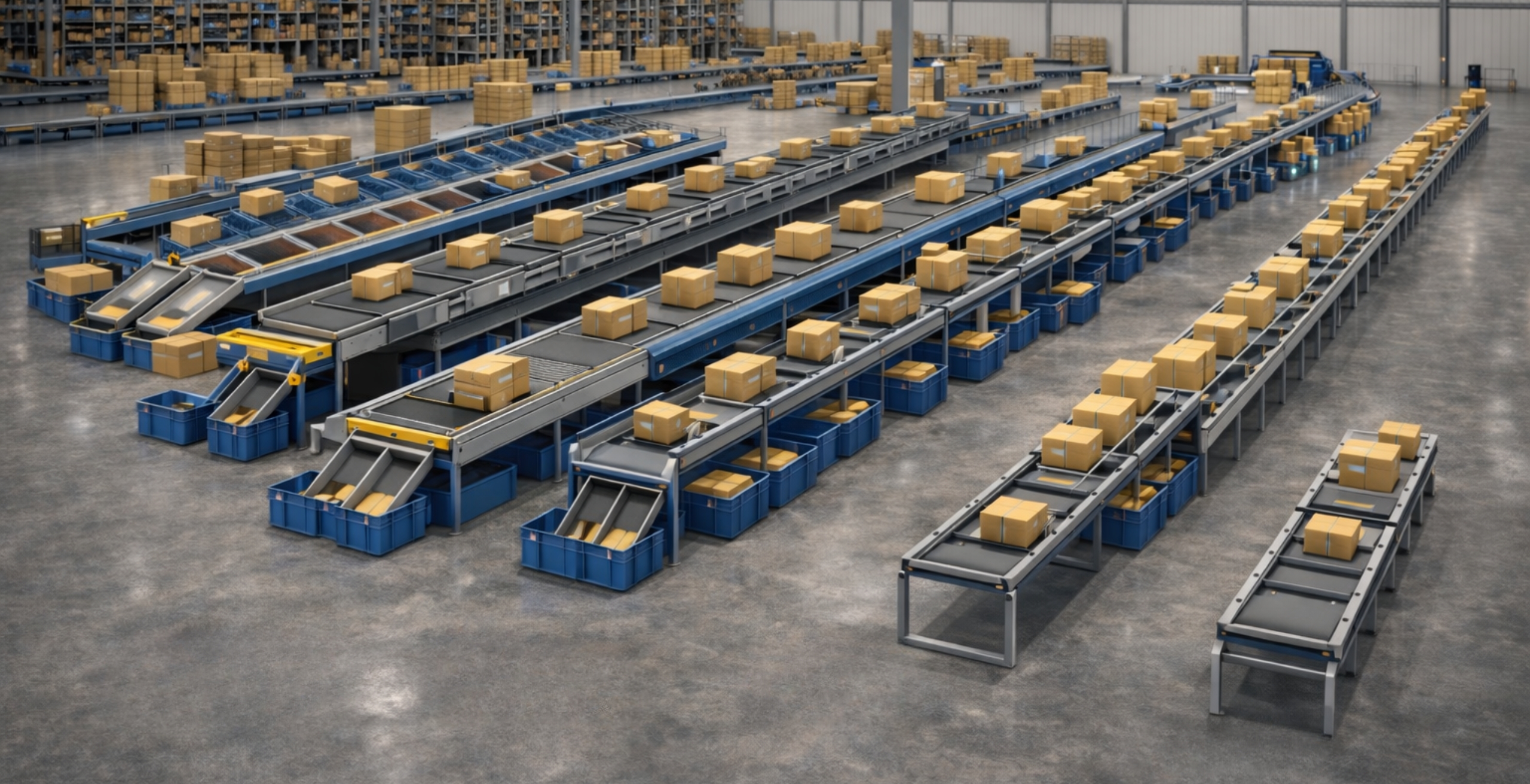
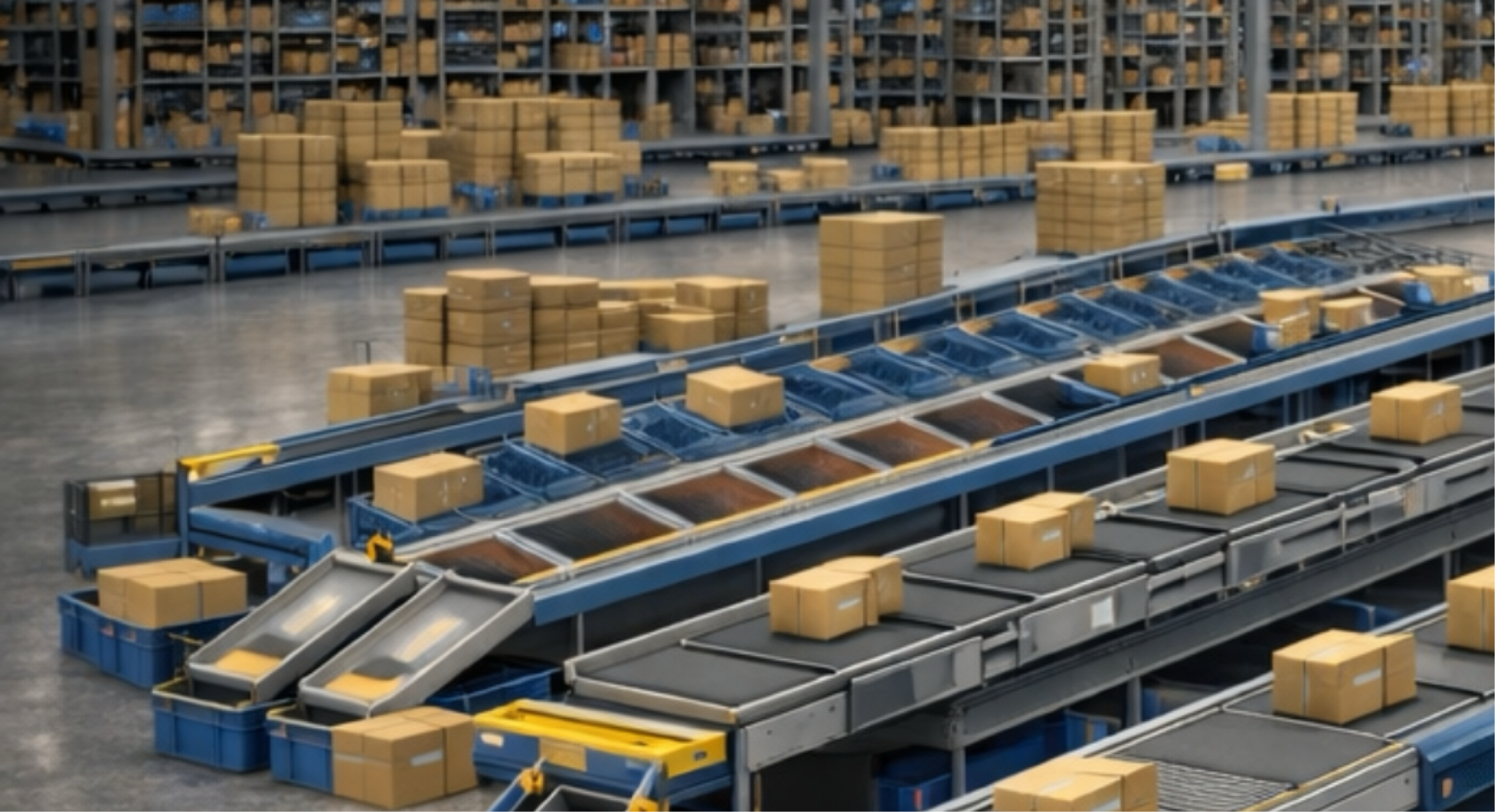
Sliding shoe sorters employ rows of small, independently controlled diverting mechanisms, “shoes”, mounted on a continuous conveyor. As items travel along the main line, the control system activates shoes beneath specific products, causing them to slide laterally across the conveyor surface and onto take-away lanes or chutes positioned along the sorter’s sides.
The system comprises the main conveyor belt with embedded shoe mechanisms, rows of sliding shoes arranged diagonally across the conveyor width, actuators (typically pneumatic or electromagnetic) that drive shoe movement, high-speed scanners positioned at induction points, and control systems managing the precise timing of shoe activation. Individual shoes move only when required for a divert, returning to the home position for the next step. Multiple shoes typically activate simultaneously to generate sufficient force for reliable diversion.
2
Cross-Belt Sorters
×
Cross-Belt Sorters
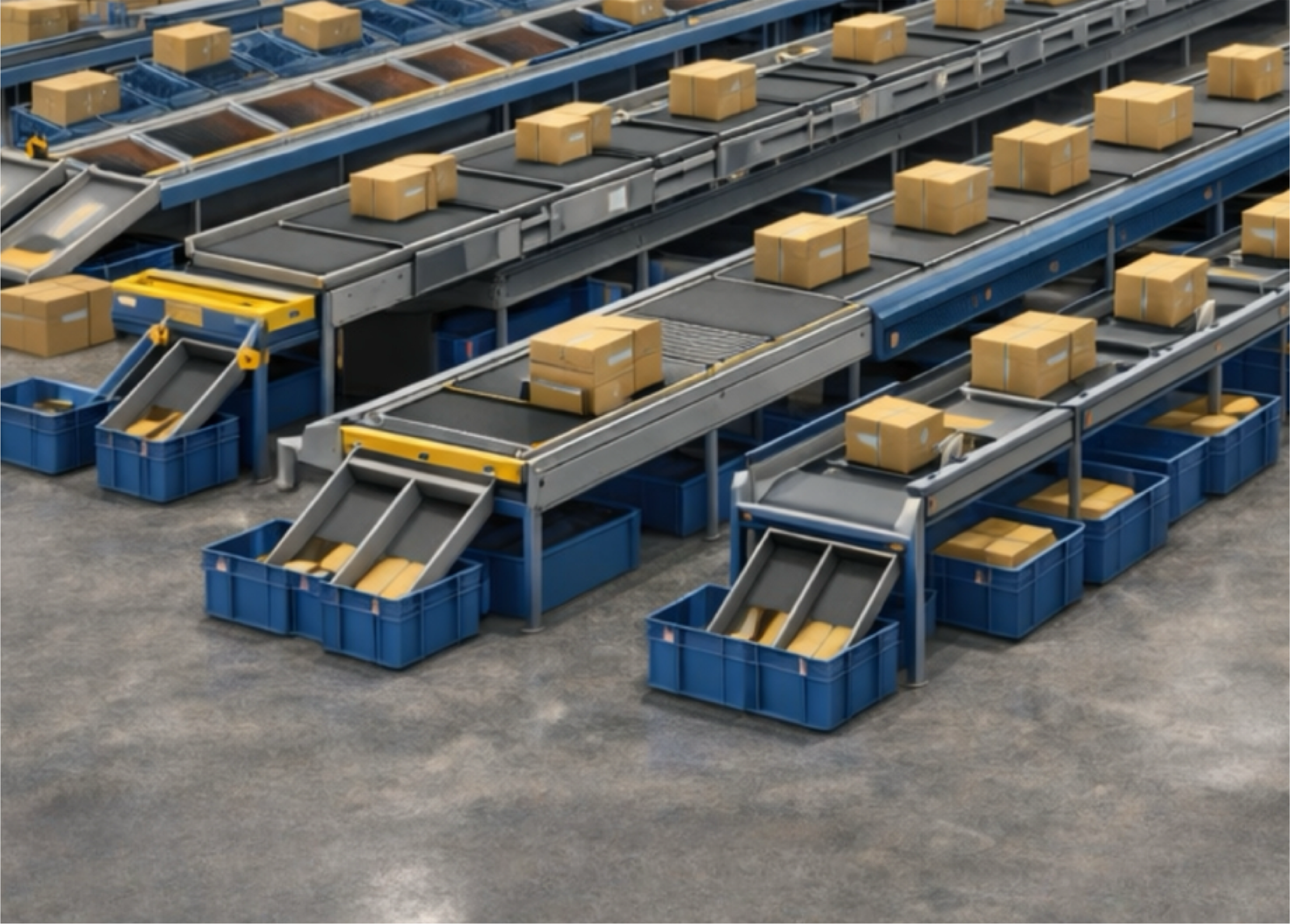
A cross-belt sorter system employs individual carriers, each equipped with its own short belt conveyor, travelling around a continuous loop. Items load onto these carriers at induction points, and when a carrier reaches the appropriate discharge location, its integral belt activates, conveying the item laterally off the main loop onto a chute or take-away system.
The system comprises numerous independent carriers travelling on a loop track, each carrier featuring a powered belt running perpendicular to the travel direction, induction systems that place items onto moving carriers (often including dynamic singulation and gap creation), scanning systems that identify items and assign them to specific carriers, and control systems managing carrier positions and belt activation timing. Power delivery to individual carrier belts typically uses sliding contacts along the track.
3
Tilt-Tray Sorters
×
Tilt-Tray Sorters
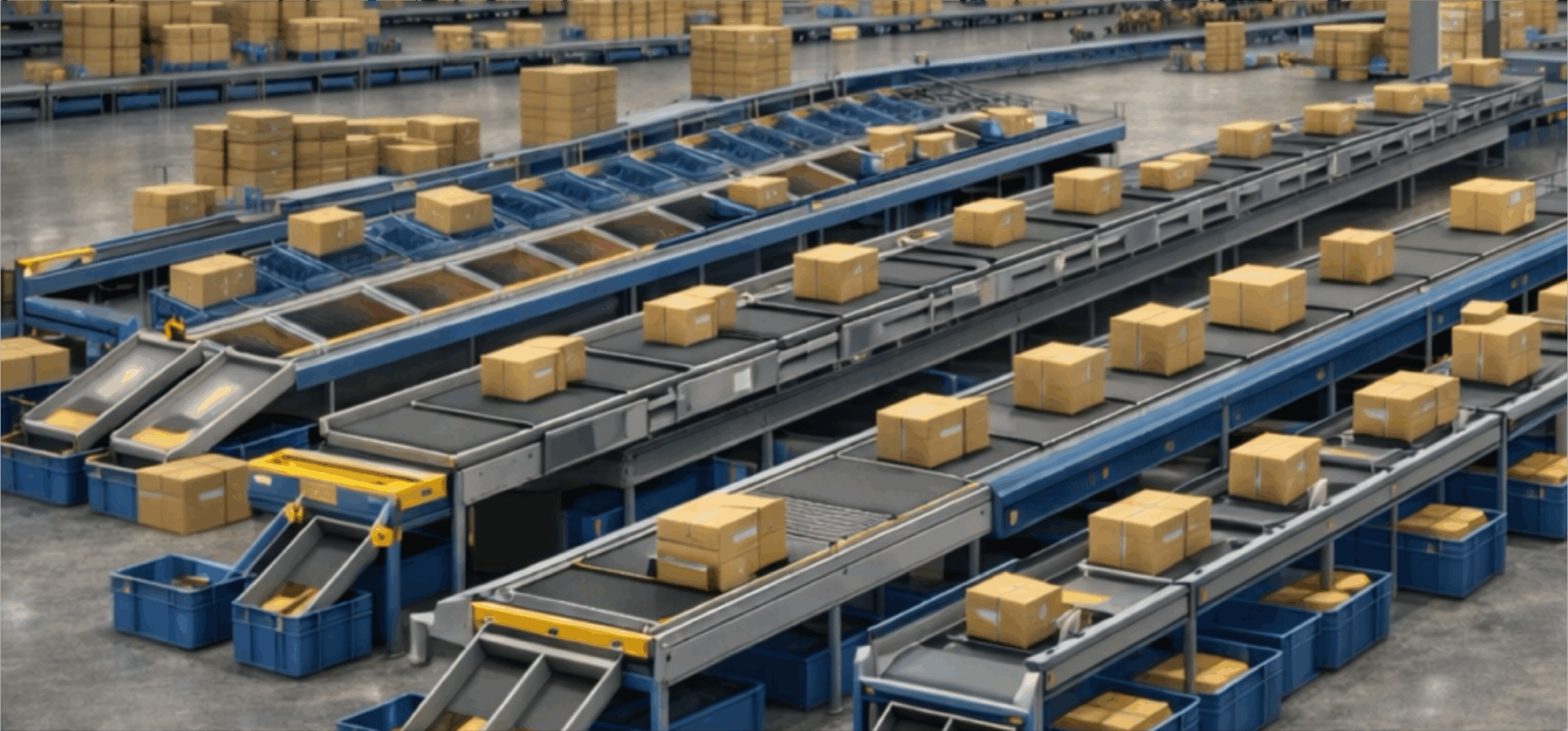
Tilt tray sorters employ individual trays travelling around a continuous track, with each tray capable of tilting to discharge its load onto chutes positioned along the loop. Items load onto trays at induction points, travel to assigned discharge locations, and drop via gravity when trays tilt.
The system comprises numerous trays mounted on a continuous chain or track, tilt mechanisms (mechanical, pneumatic, or electromagnetic) that activate individual trays, induction systems placing items onto moving trays, scanning and identification systems, and control systems managing tray assignments and activation points. Trays typically tilt 30-45 degrees to ensure reliable discharge, then return to horizontal for the next induction cycle.
4
Pop-Up Wheel Sorters
×
Pop-Up Wheel Sorters
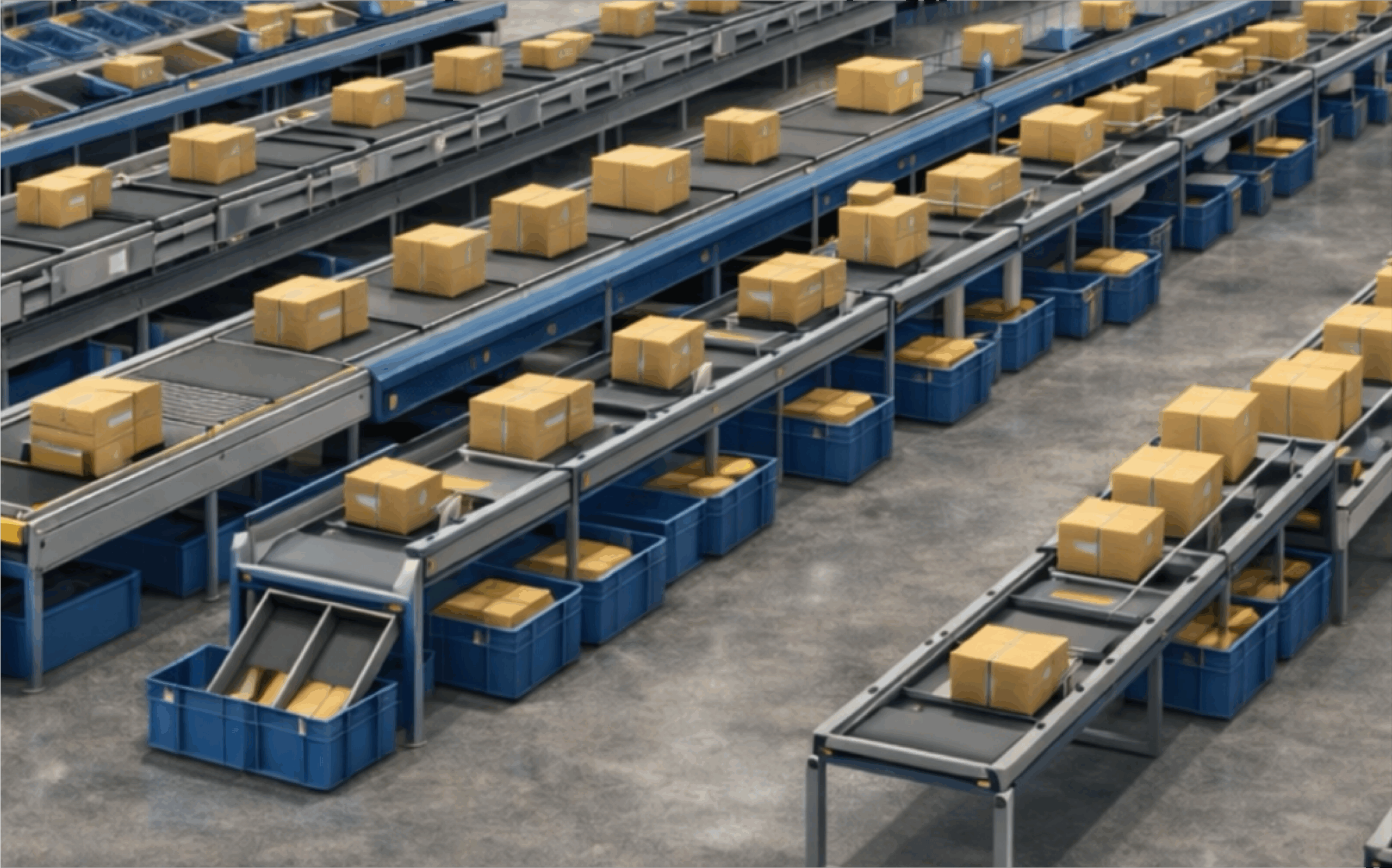
Pop-up wheel sorters employ sets of wheels mounted between powered conveyor rollers, positioned at each divert location along the main line. When the control system signals a divert, pneumatic cylinders raise the appropriate wheel set above the conveyor surface. These angled wheels contact the bottom of the item, spinning it laterally off the main conveyor onto a take-away lane.
The system comprises powered roller conveyors forming the main line, wheel modules positioned at each sort location (typically containing 4-8 wheels arranged at 30-45 degree angles), pneumatic or electric actuators that raise wheels above the roller surface, scanners identifying products and determining divert requirements, and control systems managing activation timing. Some implementations use steerable wheels that can divert items in either direction from a single mechanism.
5
Narrow Belt Sorters
×
Narrow Belt Sorters
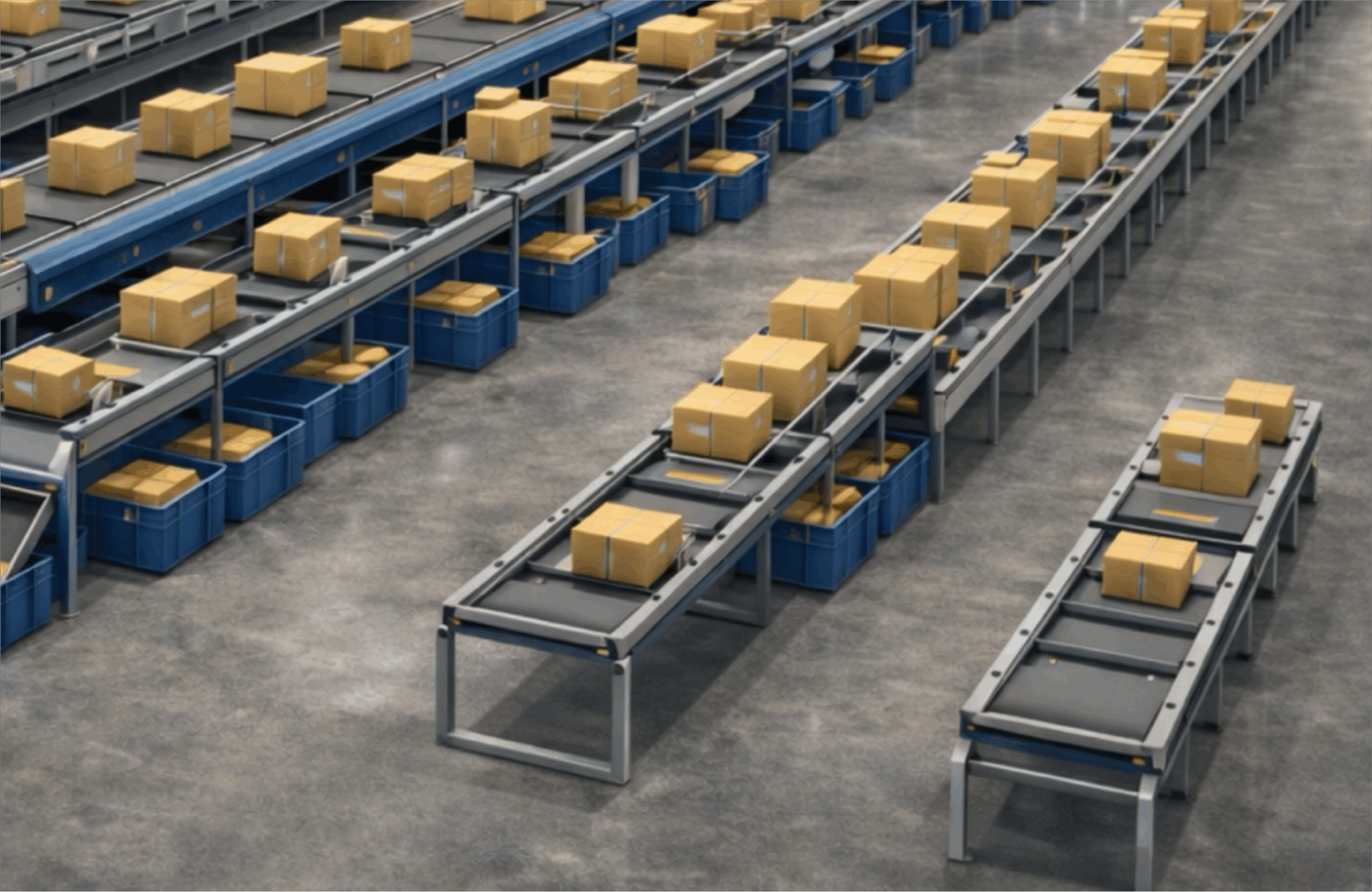
Narrow belt sorters employ multiple parallel, independently controlled narrow belts (typically 75-150mm wide) running across the width of the main conveyor. When an item requires diversion, the appropriate narrow belts activate beneath it, conveying the product laterally across idle belts to a take-away lane.
The system comprises the main conveyor structure supporting numerous narrow belts arranged perpendicular to product flow, individual drive mechanisms for each narrow belt (or groups of belts), scanning and identification systems, and control systems managing belt activation patterns. Products ride across the narrow belts on the main conveyor until specific belts activate beneath them, creating lateral movement. Multiple adjacent belts typically activate together to generate sufficient force for reliable diversion.
6
Push Tray Sorters
×
Push Tray Sorters
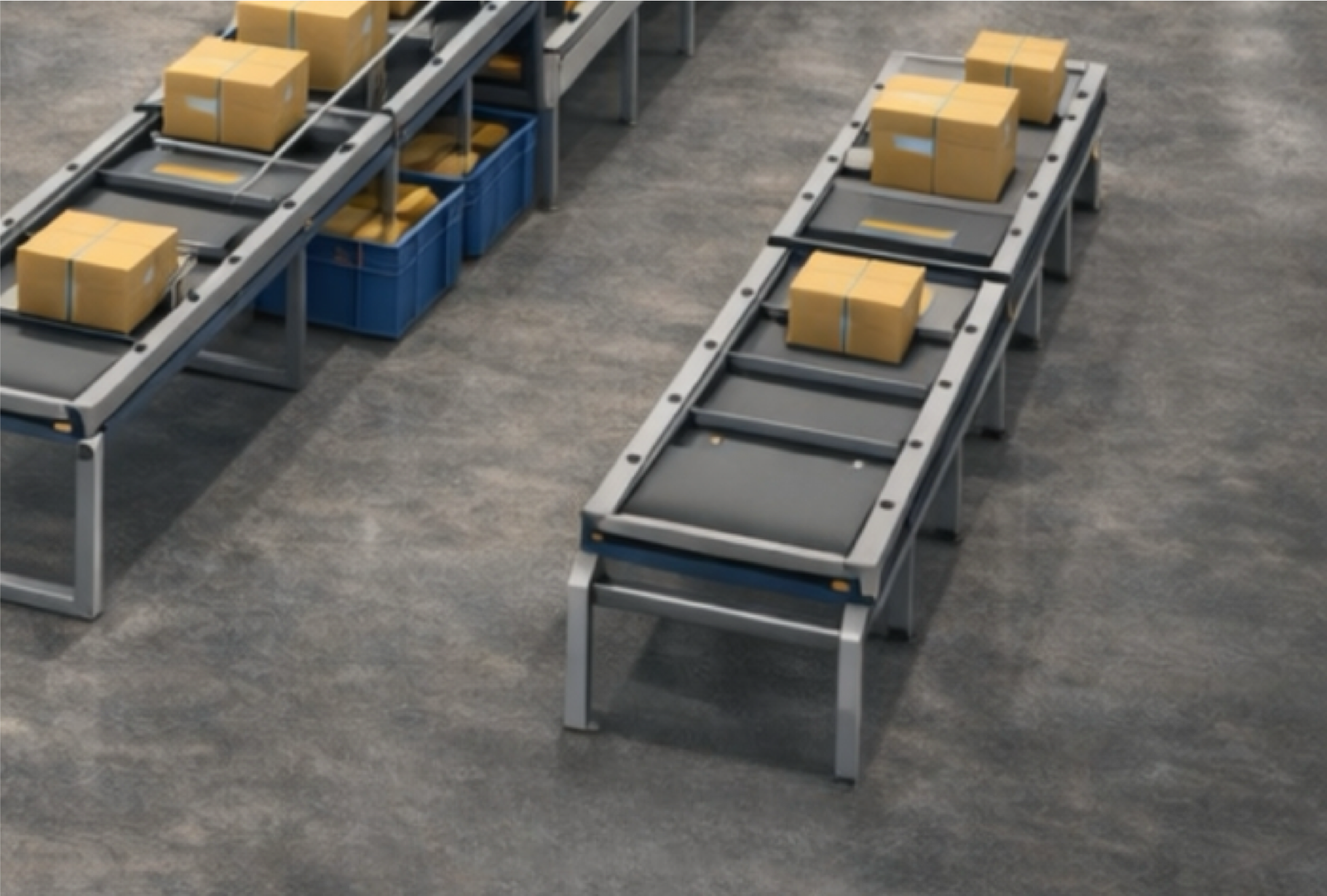
Push tray sorters employ trays or carriers travelling around a loop, each equipped with a powered pushing mechanism. Items load onto trays at induction, and when trays reach assigned discharge locations, the pusher activates, shoving items off the tray onto chutes or take-away systems. Unlike tilt-tray systems that use gravity, push mechanisms provide a positive discharge force.
The system comprises carriers mounted on a continuous track, pusher mechanisms on each carrier (often powered rails running along the discharge side of the track that engage pusher arms), induction systems loading items onto moving carriers, scanning and identification equipment, and control systems managing carrier assignments and pusher activation. The positive push action enables discharge even for heavy or high-friction items that might not release reliably from tilt-tray systems.
1
Sliding Shoe Sorters
Sliding Shoe Sorters
Sliding shoe sorters employ rows of small, independently controlled diverting mechanisms, “shoes”, mounted on a continuous conveyor. As items travel along the main line, the control system activates shoes beneath specific products, causing them to slide laterally across the conveyor surface and onto take-away lanes or chutes positioned along the sorter’s sides.
The system comprises the main conveyor belt with embedded shoe mechanisms, rows of sliding shoes arranged diagonally across the conveyor width, actuators (typically pneumatic or electromagnetic) that drive shoe movement, high-speed scanners positioned at induction points, and control systems managing the precise timing of shoe activation. Individual shoes move only when required for a divert, returning to the home position for the next step. Multiple shoes typically activate simultaneously to generate sufficient force for reliable diversion.
2
Cross-Belt Sorters
Cross-Belt Sorters
A cross-belt sorter system employs individual carriers, each equipped with its own short belt conveyor, travelling around a continuous loop. Items load onto these carriers at induction points, and when a carrier reaches the appropriate discharge location, its integral belt activates, conveying the item laterally off the main loop onto a chute or take-away system.
The system comprises numerous independent carriers travelling on a loop track, each carrier featuring a powered belt running perpendicular to the travel direction, induction systems that place items onto moving carriers (often including dynamic singulation and gap creation), scanning systems that identify items and assign them to specific carriers, and control systems managing carrier positions and belt activation timing. Power delivery to individual carrier belts typically uses sliding contacts along the track.
3
Tilt-Tray Sorters
Tilt-Tray Sorters
Tilt tray sorters employ individual trays travelling around a continuous track, with each tray capable of tilting to discharge its load onto chutes positioned along the loop. Items load onto trays at induction points, travel to assigned discharge locations, and drop via gravity when trays tilt.
The system comprises numerous trays mounted on a continuous chain or track, tilt mechanisms (mechanical, pneumatic, or electromagnetic) that activate individual trays, induction systems placing items onto moving trays, scanning and identification systems, and control systems managing tray assignments and activation points. Trays typically tilt 30-45 degrees to ensure reliable discharge, then return to horizontal for the next induction cycle.
4
Pop-Up Wheel Sorters
Pop-Up Wheel Sorters
Pop-up wheel sorters employ sets of wheels mounted between powered conveyor rollers, positioned at each divert location along the main line. When the control system signals a divert, pneumatic cylinders raise the appropriate wheel set above the conveyor surface. These angled wheels contact the bottom of the item, spinning it laterally off the main conveyor onto a take-away lane.
The system comprises powered roller conveyors forming the main line, wheel modules positioned at each sort location (typically containing 4-8 wheels arranged at 30-45 degree angles), pneumatic or electric actuators that raise wheels above the roller surface, scanners identifying products and determining divert requirements, and control systems managing activation timing. Some implementations use steerable wheels that can divert items in either direction from a single mechanism.
5
Narrow Belt Sorters
Narrow Belt Sorters
Narrow belt sorters employ multiple parallel, independently controlled narrow belts (typically 75-150mm wide) running across the width of the main conveyor. When an item requires diversion, the appropriate narrow belts activate beneath it, conveying the product laterally across idle belts to a take-away lane.
The system comprises the main conveyor structure supporting numerous narrow belts arranged perpendicular to product flow, individual drive mechanisms for each narrow belt (or groups of belts), scanning and identification systems, and control systems managing belt activation patterns. Products ride across the narrow belts on the main conveyor until specific belts activate beneath them, creating lateral movement. Multiple adjacent belts typically activate together to generate sufficient force for reliable diversion.
6
Push Tray Sorters
Push Tray Sorters
Push tray sorters employ trays or carriers travelling around a loop, each equipped with a powered pushing mechanism. Items load onto trays at induction, and when trays reach assigned discharge locations, the pusher activates, shoving items off the tray onto chutes or take-away systems. Unlike tilt-tray systems that use gravity, push mechanisms provide a positive discharge force.
The system comprises carriers mounted on a continuous track, pusher mechanisms on each carrier (often powered rails running along the discharge side of the track that engage pusher arms), induction systems loading items onto moving carriers, scanning and identification equipment, and control systems managing carrier assignments and pusher activation. The positive push action enables discharge even for heavy or high-friction items that might not release reliably from tilt-tray systems.
1
Warehouse Management System
×
Warehouse Management System
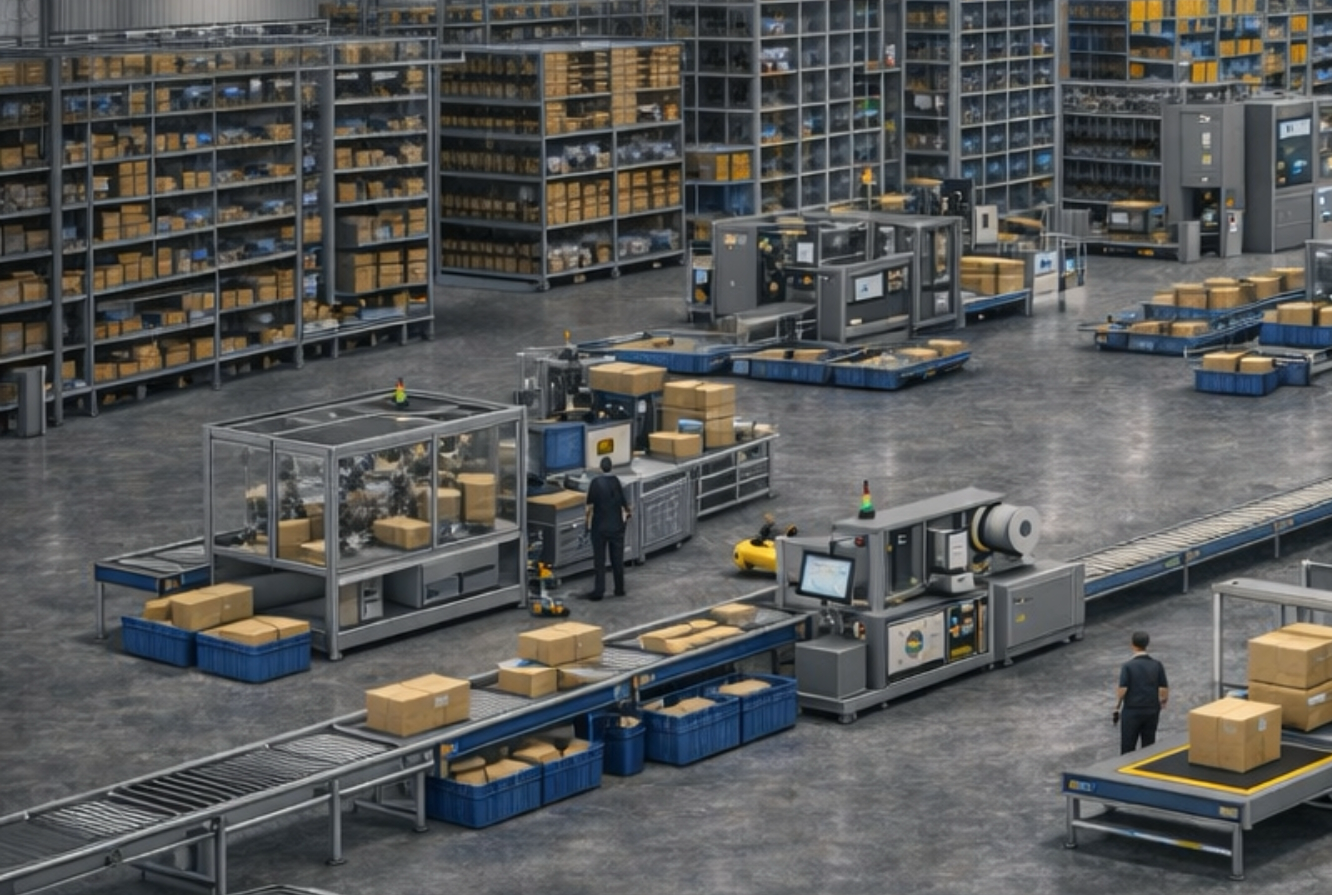
A warehouse management system serves as the operational brain of distribution facilities, managing inventory, orchestrating order fulfilment, directing labour, and coordinating activities required for efficient operations. The WMS (warehouse management system) replaces manual processes, paper-based systems, spreadsheets, visual warehouse walks, and ad-hoc storage decisions with systematic, data-driven workflows. Core functionality includes inventory tracking (stock levels, locations, lot numbers, expiry dates), receipt processing and putaway optimisation, order management from release through shipping, labour tracking and productivity metrics, and comprehensive reporting.
Distribution centres serving retail stores, e-commerce fulfilment operations, third-party logistics providers, manufacturing facilities, and pharmaceutical warehouses all rely on warehouse inventory management systems to manage complex operations whilst maintaining regulatory compliance. Benefits include inventory accuracy improvements to 99%+, order accuracy reaching 99.9%+, labour productivity increases of 15-30%, space utilisation improvements of 20-40%, and the data foundation necessary for continuous improvement through performance visibility and analytical capabilities.
2
Warehouse Control System
×
Warehouse Control System
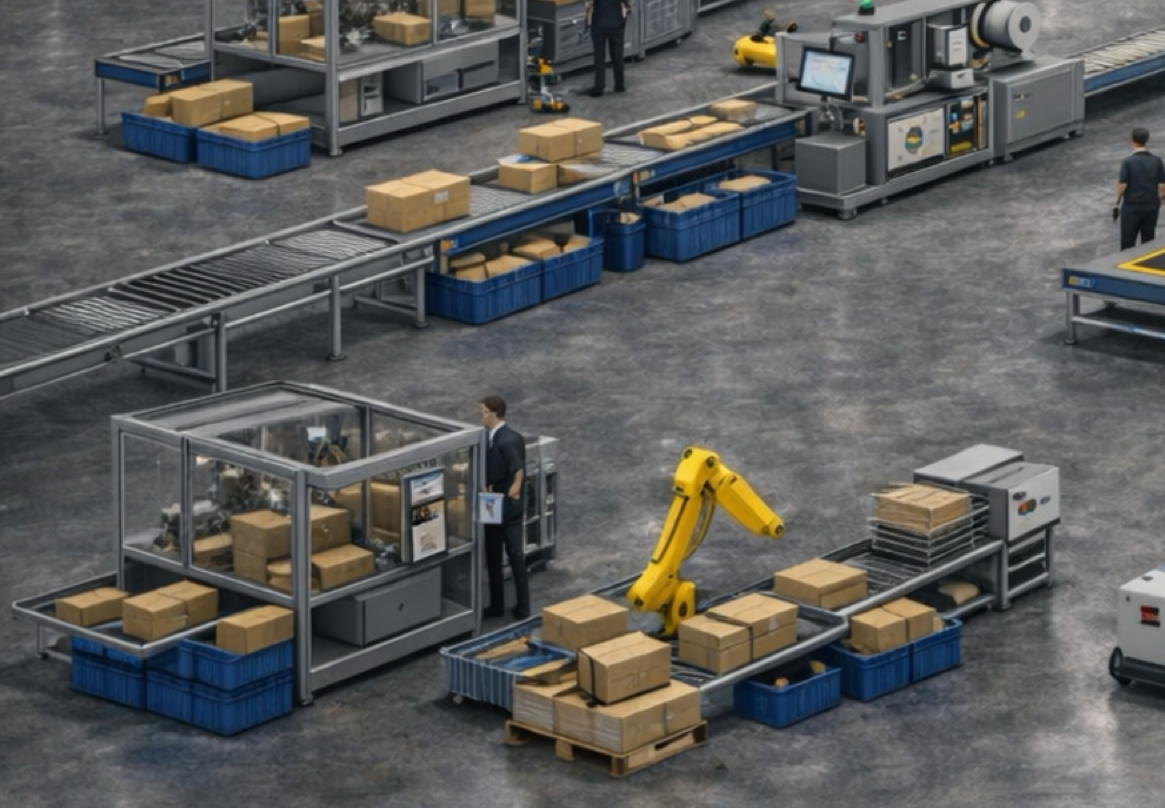
An automated warehouse control system functions as the real-time orchestration layer between warehouse management systems and physical automation equipment, translating strategic WMS instructions into specific equipment commands whilst optimising sequences for maximum throughput. The warehouse stock control system manages conveyor routing through complex networks, prevents traffic conflicts at intersections and merges, sequences equipment operations for efficiency, monitors equipment status and performance, and coordinates communication between WMS and equipment controllers.
Applications include automated storage and retrieval systems requiring crane coordination, sortation systems managing item flow and diversion, conveyor networks routing items through complex paths, and robotic systems (AGVs, AMRs, palletising robots) requiring conflict prevention and task optimisation. Benefits include throughput improvements of 15-25% through continuous operational adjustment, substantial decreases in equipment conflicts and jams, improved maintenance efficiency through performance trend tracking, simplified integration providing standardised WMS interfaces, and scalability allowing equipment additions without redesigning control logic.
3
Warehouse Execution System
×
Warehouse Execution System
A WES warehouse execution system combines elements of warehouse management and control systems, managing both operational execution and equipment coordination in a unified platform rather than maintaining distinct WMS and WCS layers. Core functionality spans order orchestration with wave planning and task generation, resource optimisation, allocating labour and equipment, execution management, coordinating picking and packing activities, equipment control, managing conveyors and robots, and real-time performance tracking.
E-commerce fulfilment centres with high automation levels, omnichannel retailers serving both store replenishment and direct-to-consumer orders, high-volume distribution centres, third-party logistics operations managing multiple clients, and facilities undergoing automation phasing all benefit from WES coordination capabilities. Benefits include unified optimisation delivering superior performance compared to separate systems, making independent decisions, decreased implementation complexity, lower total cost of ownership, improved real-time responsiveness, comprehensive single-platform visibility, simplified change management, and improved vendor accountability with single-supplier responsibility.
4
Real-Time Location Systems
×
Real-Time Location Systems
Real-time location systems provide continuous visibility into asset positions throughout facilities using wireless technologies, RFID (passive or active), ultra-wideband radio (30cm accuracy), Bluetooth Low Energy, GPS for outdoor yards, or computer vision, to track pallets, totes, equipment, tools, and personnel. Real-time locating systems replace manual asset searches, periodic cycle counts, and paper-based tracking with automated monitoring that enables position tracking, zone management, dwell time analysis, route analytics, and integration with warehouse management systems for location-aware decisions.
Distribution centres tracking pallet movements, manufacturing facilities monitoring work-in-process inventory, cross-docking operations ensuring timely goods flow, maintenance operations tracking tools, and cold storage facilities minimising worker exposure all deploy RTLS for operational visibility. Benefits include labour productivity improvements of 15-30 minutes saved per worker per shift, increased inventory accuracy through continuous tracking, process visibility enabling proactive management, improved asset utilisation, faster throughput through quicker delay resolution, enhanced customer service with reliable delivery commitments, strengthened compliance for chain-of-custody documentation, and continuous improvement capabilities through historical analysis.
1
Warehouse Management System
Warehouse Management System
A warehouse management system serves as the operational brain of distribution facilities, managing inventory, orchestrating order fulfilment, directing labour, and coordinating activities required for efficient operations. The WMS (warehouse management system) replaces manual processes, paper-based systems, spreadsheets, visual warehouse walks, and ad-hoc storage decisions with systematic, data-driven workflows. Core functionality includes inventory tracking (stock levels, locations, lot numbers, expiry dates), receipt processing and putaway optimisation, order management from release through shipping, labour tracking and productivity metrics, and comprehensive reporting.
Distribution centres serving retail stores, e-commerce fulfilment operations, third-party logistics providers, manufacturing facilities, and pharmaceutical warehouses all rely on warehouse inventory management systems to manage complex operations whilst maintaining regulatory compliance. Benefits include inventory accuracy improvements to 99%+, order accuracy reaching 99.9%+, labour productivity increases of 15-30%, space utilisation improvements of 20-40%, and the data foundation necessary for continuous improvement through performance visibility and analytical capabilities.
2
Warehouse Control System
Warehouse Control System
An automated warehouse control system functions as the real-time orchestration layer between warehouse management systems and physical automation equipment, translating strategic WMS instructions into specific equipment commands whilst optimising sequences for maximum throughput. The warehouse stock control system manages conveyor routing through complex networks, prevents traffic conflicts at intersections and merges, sequences equipment operations for efficiency, monitors equipment status and performance, and coordinates communication between WMS and equipment controllers.
Applications include automated storage and retrieval systems requiring crane coordination, sortation systems managing item flow and diversion, conveyor networks routing items through complex paths, and robotic systems (AGVs, AMRs, palletising robots) requiring conflict prevention and task optimisation. Benefits include throughput improvements of 15-25% through continuous operational adjustment, substantial decreases in equipment conflicts and jams, improved maintenance efficiency through performance trend tracking, simplified integration providing standardised WMS interfaces, and scalability allowing equipment additions without redesigning control logic.
3
Warehouse Execution System
Warehouse Execution System
A WES warehouse execution system combines elements of warehouse management and control systems, managing both operational execution and equipment coordination in a unified platform rather than maintaining distinct WMS and WCS layers. Core functionality spans order orchestration with wave planning and task generation, resource optimisation, allocating labour and equipment, execution management, coordinating picking and packing activities, equipment control, managing conveyors and robots, and real-time performance tracking.
E-commerce fulfilment centres with high automation levels, omnichannel retailers serving both store replenishment and direct-to-consumer orders, high-volume distribution centres, third-party logistics operations managing multiple clients, and facilities undergoing automation phasing all benefit from WES coordination capabilities. Benefits include unified optimisation delivering superior performance compared to separate systems, making independent decisions, decreased implementation complexity, lower total cost of ownership, improved real-time responsiveness, comprehensive single-platform visibility, simplified change management, and improved vendor accountability with single-supplier responsibility.
4
Real-Time Location Systems
Real-Time Location Systems
Real-time location systems provide continuous visibility into asset positions throughout facilities using wireless technologies, RFID (passive or active), ultra-wideband radio (30cm accuracy), Bluetooth Low Energy, GPS for outdoor yards, or computer vision, to track pallets, totes, equipment, tools, and personnel. Real-time locating systems replace manual asset searches, periodic cycle counts, and paper-based tracking with automated monitoring that enables position tracking, zone management, dwell time analysis, route analytics, and integration with warehouse management systems for location-aware decisions.
Distribution centres tracking pallet movements, manufacturing facilities monitoring work-in-process inventory, cross-docking operations ensuring timely goods flow, maintenance operations tracking tools, and cold storage facilities minimising worker exposure all deploy RTLS for operational visibility. Benefits include labour productivity improvements of 15-30 minutes saved per worker per shift, increased inventory accuracy through continuous tracking, process visibility enabling proactive management, improved asset utilisation, faster throughput through quicker delay resolution, enhanced customer service with reliable delivery commitments, strengthened compliance for chain-of-custody documentation, and continuous improvement capabilities through historical analysis.
Hatmill’s Warehouse Automation Process
Click on each stage below to find out more about Hatmill’s Warehouse Automation Process
Business Strategy
Logistics Strategy
Customer Proposition
Scoping & Discovery
Requirement Options
Concept Deployment
High Level Solutions Design
Business Case Development
Tender
Evaluation
Selection
Business Case Sign-off
Detailed Design
Implementation
Testing
Go Live
Strategy
Development
Selection
Delivery
Hatmill
Warehouse Automation Services
Our expert logistics consultants will work with you to understand your unique business needs and provide recommendations on how best to optimise your warehouse automation system.
Selecting Warehouse Automation Technology
Our warehousing and logistics experts will work with you to understand your business and offer guidance on the best warehouse automation technology tailored to your unique business needs. This will ensure your business remains competitive and adaptable to changing market demands.
Warehouse Automation Design
With the help of our warehousing experts, you can be confident that your warehouse automation design is built to support your business’s unique needs and future growth.
Warehouse Automation Implementation
With our warehousing experts on board, implementing your warehouse automation system is guaranteed to be a smooth and efficient process. We’ll ensure the solution is tailored to support your business’s unique needs and future growth plans.
Warehouse Automation Optimisation
With our warehousing consultants on board, optimising your warehouse automation system is guaranteed to be a smooth and efficient process. We’ll ensure your automation solution is perfectly tailored to support your business’s unique needs and future growth plans.
What should you know
-
What is warehouse automation, and how does it work?
Warehouse automation is the use of physical material-handling equipment—such as conveyors, sorters, shuttles, AS/RS, and automated warehouse robots—coordinated by software (WMS/WCS) to move, store, and process goods with minimal manual effort. In practice, sensors scan items, the WMS allocates work, and the WCS/PLC layers drive equipment to execute tasks, including receiving, put-away, picking, packing, and dispatch. Humans handle value-add and exceptions, while automated warehouse systems standardise repetitive movements for consistency, safety, and speed. The key is tight integration between equipment and software, validated through testing (FAT/SAT/volume) before going live, ensuring stable performance from day one.
-
What are the main types of automation used in warehouses?
Core categories include storage and retrieval (AS/RS, shuttles, miniloads), mobile movement (AMRs/AGVs), conveyance and sortation (conveyors, unit/case sorters), robotic handling (robot arms for picking, palletising/depalletising), and end-of-line automation, all integrated by WMS/WCS. The right mix depends on unit loads, order profiles, space, labour and service promises. We compare alternatives, model flows, and stress-test against peaks and downtime before recommending a preferred concept. This avoids over-specifying and ensures automated warehouse solutions support both today’s demand and future growth.
-
How do automated warehouses perform compared to manual operations?
When correctly specified and delivered, automated warehouses achieve higher throughput, better accuracy, safer ergonomics and more reliable peak performance than manual operations. Automation reduces walking and manual touches, buffers work with accumulation, and smooths variability, so service levels are less exposed to labour shortages or spikes. Results depend on good data, sound layout, robust software integration and change management. We validate claims with modelling and staged testing, so the automated warehouse system starts stable, then we embed continuous improvement to sustain benefits.
-
At what point does it make sense to automate warehouse processes?
It makes sense when a data-backed case shows automation can meet your service requirements more reliably and cost-effectively than manual or mechanised options. Typical triggers include sustained labour pressure, space constraints, rising error rates, health and safety risks, or growth/seasonal peaks you cannot consistently handle. We start with feasibility: baseline flows, size options, run sensitivities and compare scenarios including “do nothing.” If the business case clears your hurdle rate and the risk is manageable, we proceed; if not, we’ll recommend lower-cost improvements and a roadmap.
-
How much does a warehouse automation system cost?
Costs vary by scope, technology, scale and building constraints; there is no single price. Capex typically includes equipment, software, integration, controls, installation, enabling works, and commissioning; opex covers services, spares, energy, and support. Our approach is to create ROM estimates from concepts, then refine through competitive tender with automated warehouse companies and clear inclusions/exclusions. We always include the “hidden” costs, IT changes, training, ramp-up, and temporary measures to give a realistic total investment view before approval.
-
What is the ROI for investing in warehouse automation?
ROI is calculated by comparing the operational benefits of automation, primarily labour and efficiency savings—with the total cost of ownership. We use practical measures to compare the benefits of a manual and an automated system in reducing FTE requirements and delivering OPEX benefits. Acting against this are annual maintenance costs, spares and energy for automated warehouse systems. We build business cases that net these factors, then apply hurdle rates and sensitivity analysis. A positive net benefit, validated by data, and a disciplined benefits-tracking plan are as significant as the kit you buy.
-
What levels of automation can be implemented in a warehouse?
Levels span from mechanised aids (conveyors, pick-to-light) through semi-automated (AMRs with manual pick) to highly automated goods-to-person and, in limited cases, “dark” warehouses. Most operations land on a hybrid: automate the constraint, keep flexible tasks manual, and scale in phases. We have a framework tool to help map where you are and where to target next, while a vendor-neutral design prevents over-specifying.
-
Are automated warehouses more eco-friendly than traditional ones?
Often, yes: when designed well, automation can cut travel, reduce damage, and enable denser storage, which reduces the building footprint and energy per unit moved. However, equipment has embodied carbon and ongoing power needs, so the whole-life view matters. Our dedicated sustainability SMEs can assess energy, materials, maintenance and controls strategies (sleep modes, smart charging) to ensure automated warehouse solutions reduce emissions without compromising service or safety.
-
Can a warehouse be fully automated from end to end?
It’s technically possible in specific contexts (“dark” warehouses), but rarely optimal across all tasks and product profiles. Variability, fragility, exception rates and commercial change usually favour a blended approach to automation, where it adds the most value, and humans where flexibility matters. We design for right-sizing, robust exception handling and safe collaboration rather than pursuing 100% automation at any cost.
-
How do warehouse staff adapt to working alongside automation?
They adapt well to early engagement, clear roles, good training, and a safe, ergonomic design. We involve teams in discovery, conduct change impact assessments, update SOPs, and coordinate hands-on training before going live. Automation shifts work from travel and lifting to monitoring, exception handling, and value-add tasks; this generally improves safety and retention while maintaining service through peaks.
About Hatmill
We are one team
All the team benefit from the financial success of Hatmill, through performance bonuses and a non-contributory share option scheme. Many of the team work virtually which reduces overheads. These cost savings can be passed onto clients. Hatmill compete against the big consultancy firms but one of the things that sets us apart is our relentless cost focus which means we are often better value than our competitors.
Case Studies
Our Work
How we’ve delivered improvements and outstanding results for our clients.